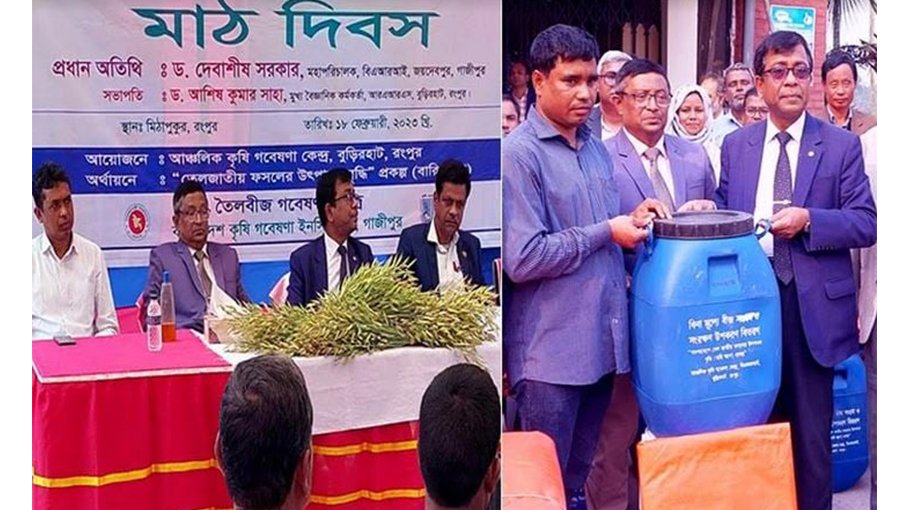
Bangladesh Agricultural Research Institute (BARI) Director General Agriculturist Debasish Sarker has urged farmers to cultivate more BARI Sarisa-14 for increasing production of oil seeds to meet edible oil demand locally.
"Necessary assistance and inputs are being provided to the farmers for expanding cultivation of the highly profitable, short duration and high yielding variety of mustard as an interim crop on fallow lands in between Aman rice and Boro rice farming," he said.
The BARI Chief said this while addressing a farmers' field day function titled 'Productivity of BARI
Sarisa-14 and production technology' held at village Tahiarpur in Mithapukur upazila here on Saturday afternoon as the chief guest.
The Regional Agricultural Research Station (RARS) at Burirhat in Rangpur of Bangladesh Agricultural Research Institute (BARI) organised the event.
Chief Scientific Officer of RARS of BARI at Burirhat in Rangpur Agriculturist Dr Ashis Kumar Saha presided over the function.
Principal Scientific Officer (PSO) of On-Farm Research Division (OFRD) of BARI at Alamnagar in Rangpur Dr Al-Amin Hossain Talukder, PSO of RARS at Burirhat Anwar Zahid, PSO of OFRD of BARI at Gaibandha Dr Abdullah Al
Mahmud and Senior Scientific Officer of Bangladesh Rice Research Institute Dr Rakibul Hasan spoke as special guests.
The agriculturists said BARI Sarisa-14, evolved by BARI, is a high yielding variety of mustard with a short life span of 75-80 days.
BARI Sarisa-14 can be cultivated as an interim crop in the high and medium high lands that remain fallow between cultivation of Aman rice and Boro rice.
Farmer Kamruzzaman said he has been cultivating BARI Sarisa-14 on his cropland since 2019-2020 crop seasons with assistance of the RARS at Burirhat to reap huge profits.
"I am getting 20 mounds (every 40 kgs) of BARI Sarisa-14 per acre of land," he said.
Farmer Hossain Ali said he cultivated BARI Sarisa-14 on the same land after harvesting short duration and high yielding BRRI dhan75 rice, got excellent yield and transplanted Boro rice seedlings on time.
"Alongside reaping more profits, cultivation of mustard helps farmers get edible oils, fodders, fuel and organic fertilizers," he added.
Dr Rakibul said he would increase supply seeds of short duration and high yielding varieties of BRRI dhan75 during Aman and BRRI dhan89 during Boro seasons to promote mustard cultivation.
He suggested farmers produce and preserve seeds of BRRI dhan75 during Aman and BRRI dhan89 properly following seed production technologies. Dr Saha said the three-crop technology extension program (Aman rice-BARI Sarisa-14-Boro rice) based on BARI Sarisha-14 farming is underway to increase
crop intensity in Rangpur and Dinajpur regions where 60 exhibition plots have been set up involving local farmers.
Later, the chief guest distributed one tarpaulin sheet and two drums to each of the 28 successful mustard seed producing farmers of Rangpur division for processing and preserving their produced seeds.