Staff Correspondent
Environmentalists and experts today expressed deep concern over ongoing and proposed infrastructure development projects in Cox’s Bazar, warning that unplanned urbanization, forest clearance, and coastal alteration pose a severe threat to the region's fragile ecology.
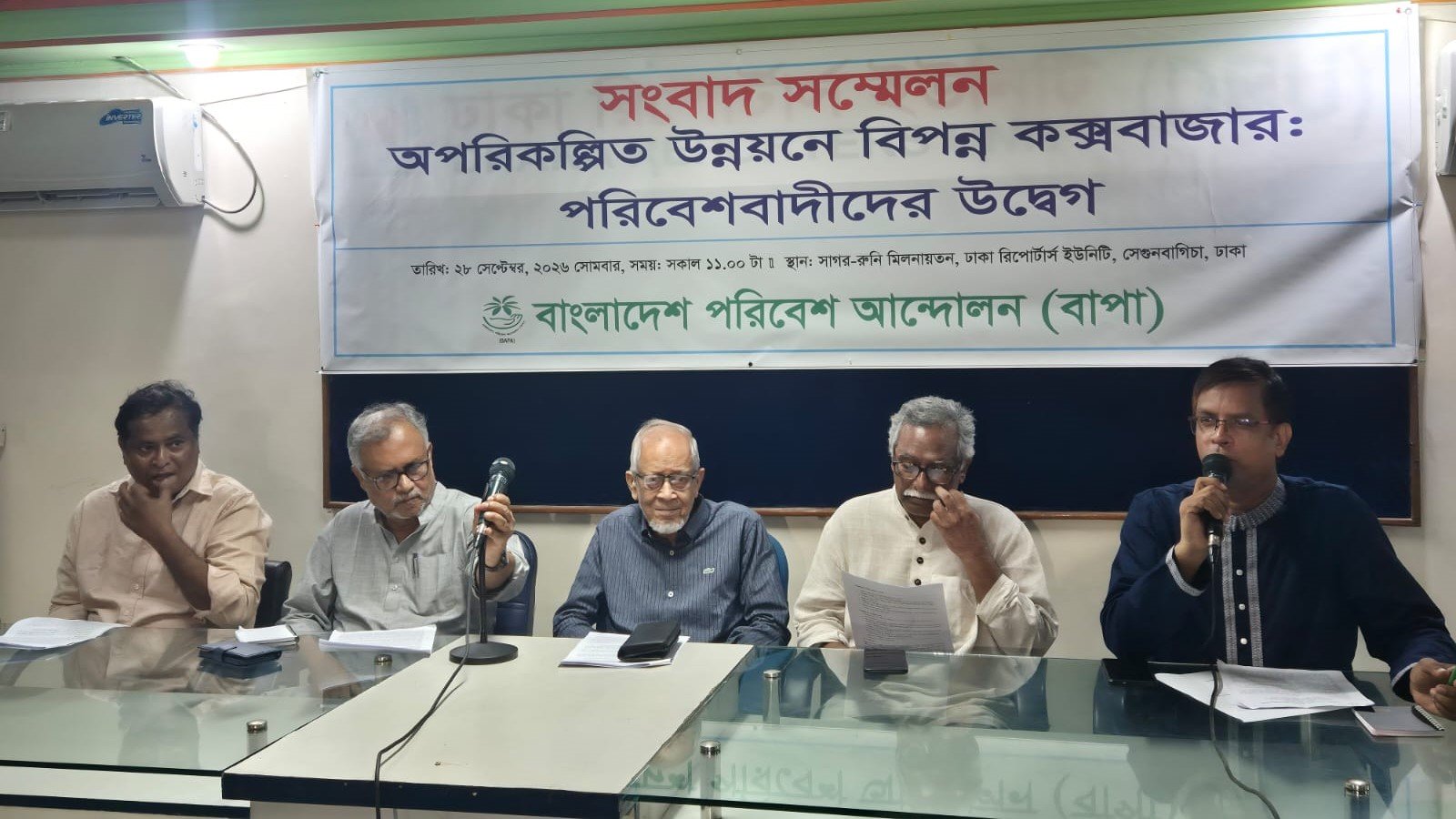
The concerns were voiced during a press conference titled “Endangered Cox’s Bazar in Unplanned Development: Concerns of Environmentalists,” organized by Bangladesh Poribosh Andolon (BAPA) at the Sagar-Runi Auditorium of the Dhaka Reporters Unity (DRU) in Segunbagicha.
Chaired by BAPA President Prof. Nur Mohammad Talukder and moderated by General Secretary Md. Alamgir Kabir, the written keynote paper was presented by BAPA Vice President Zakir Hossain. Prominent economist Prof. Anu Muhammad and BAPA Cox’s Bazar District Branch General Secretary Karim Ullah Kalim also addressed the press briefing.
Presenting the written address, Zakir Hossain highlighted three major ongoing violations of environmental laws: the construction of a road on the sand dunes of Sugandha-Kolatoli beach, the construction of the Kalar marchhara road through the reserved hill forest of Maheshkhali, and the destruction of mangrove forests in Sonadia Island for shrimp farming expansion.
He noted that the 1.6 km long and 28-meter wide road on Sugandha-Kolatoli beach, costing around BDT 63.50 crore, is funded by the Japan International Cooperation Agency (JICA) under the Urban Development and Urban Governance Project of Cox’s Bazar Municipality. Under the Bangladesh Environment Conservation Act (Amended 2010), Cox’s Bazar beach is designated as one of the country's 13 Ecologically Critical Areas (ECA), where such construction is prohibited.
Addressing the Maheshkhali road project, Hossain cited Forest Department records warning that approximately 18.50 hectares (85.71 acres) of forest land would be permanently damaged, affecting nearly 1,500 trees while official estimates value these trees at BDT 2 crore, their actual financial market value is approximately BDT 400 crore, he added.
Furthermore, he emphasized that Sonadia’s mangrove forest serves as a vital natural defense against cyclones and storm surges, supporting extraordinary biodiversity, including 250 fish species, 170 bird species, 15 mangrove plant species, and numerous other marine organisms.
Speaking at the event, Prof. Anu Muhammad described the projects as reckless, warning that they accelerate climate change risks. He criticized the development model, noting that hotels and infrastructure in Cox’s Bazar have been built in an unplanned manner.
He argued that JICA should be held accountable for financing ecologically damaging projects and called for a comprehensive review of past and present projects funded by the Asian Development Bank (ADB), JICA, and the World Bank.
Referring to recent comments by State Minister for LGRD Mir Shahe Alam regarding court directives on Cox's Bazar development, Prof. Anu Muhammad noted that disregarding court orders undermines the judiciary.
Prof. Nur Mohammad Talukder stated that tourists visit Cox’s Bazar to experience its natural beauty, not concrete structures, and urged the government to pull back from destructive projects.
BAPA Cox’s Bazar Secretary Karim Ullah Kalim stated that construction within 300 meters of the coastline violates ECA regulations. He urged the government to reveal its master plan and warned against privatizing the beach under the guise of development.
BAPA General Secretary Md. Alamgir Kabir criticized government agencies for executing projects without environmental clearance. He questioned how hill cutting and tree clearing continue deep inside reserved forests despite top-level policy commitments to environmental protection, urging the Environment Ministry to take strict enforcement action.
BAPA Treasurer Md. Aminur Rasul, Joint Secretaries Humayun Kabir Sumon, Javed Jahan, and Dr. Halim Dad Khan, along with Executive Members Monsefa Tripti, Fahmida Naznin, and Shakil Kabir, were also present at the conference.