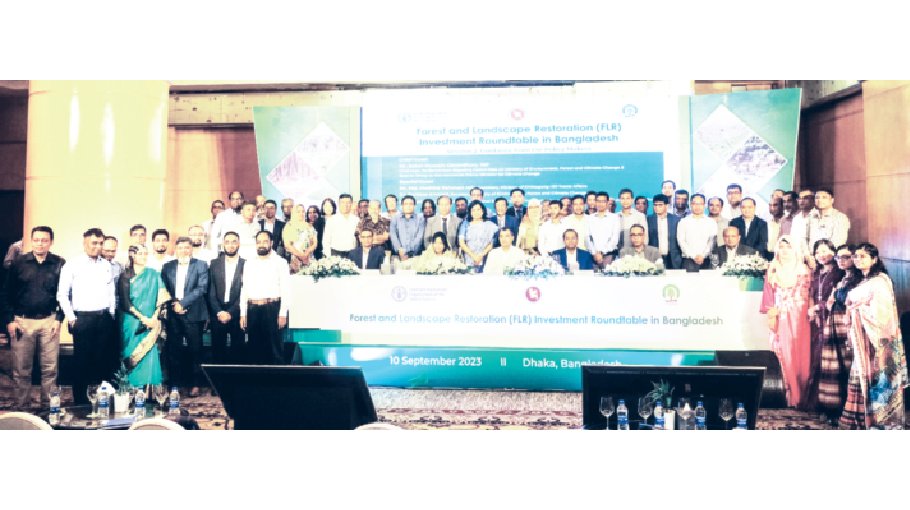
In a concerted effort to combat environmental degradation and the escalating risks posed by climate change, the Bangladesh Forest Department, in collaboration with the Food and Agriculture Organization of the United Nations (FAO), convened a pivotal event centered on forest and land restoration (FLR).
While Bangladesh has made significant strides in formulating environmental policies and legislation, the nation has borne the brunt of severe environmental deterioration in recent decades, coupled with mounting disaster threats exacerbated by climate change. Rampant land-use changes, unsustainable resource exploitation, and rapid urbanization have all taken a toll on the environment, impacting the lives and livelihoods of millions.
The restoration of degraded landscapes and the transition to sustainable practices, such as agroforestry, are recognized as vital measures to counteract the adverse effects of climate change. These measures include mitigating the increased occurrence and severity of droughts and landslides, conserving biodiversity, and bolstering soil health.
The Forest and Landscape Restoration Investment Roundtable, held in Dhaka, brought together a diverse group of experts from government bodies, businesses, and civil society. Saber Hossain Chowdhury, Honourable Chairman of the Parliamentary Standing Committee on the Ministry of Environment, Forest and Climate Change and Special Envoy to the Honourable Prime Minister for climate change, graced the occasion as the guest of honor. Special guests included Farhina Ahmed, Secretary of the Ministry of Environment, Forest and Climate Change, and Md. Mashiur Rahman NDC, Secretary of the Ministry of Chittagong Hill Tracts Affairs. The roundtable was presided over by Amir Hossain Chowdhury, Chief Conservator of Forests, Forest Department.
Nur Ahmed Khondaker, Assistant FAO Representative (Programme), delivered the opening remarks, emphasizing, "This initiative will help generate practical solutions to combat forest ecosystem degradation and reduce biodiversity loss in Bangladesh."
The roundtable was part of an FAO regional project aimed at scaling up forest and landscape restoration efforts in six countries, including Nepal, Pakistan, Lao PDR, Papua New Guinea, and Timor-Leste. This initiative is aligned with FAO's Hand-in-Hand initiative, which fosters partnership-driven approaches to accelerate agrifood systems transformation through nationally-led programs.
This roundtable also reflects Bangladesh's commitment to international climate action agreements, notably the Paris Agreement, which calls on each country to outline their post-2020 climate actions, known as their nationally determined contributions (NDCs). Bangladesh's NDC outlines plans for the restoration of degraded forest and coastal areas, emphasizing the importance of sustainable financing.
Illias Animon, Forestry Officer for FAO’s Regional Office for Asia and the Pacific, underscored the roundtable's significance in advancing investments towards achieving the country's restoration goals. He emphasized the need for more targeted and collaborative investments to promote synergies in scaling up FLR efforts, a critical step in realizing the Sustainable Development Goals.”