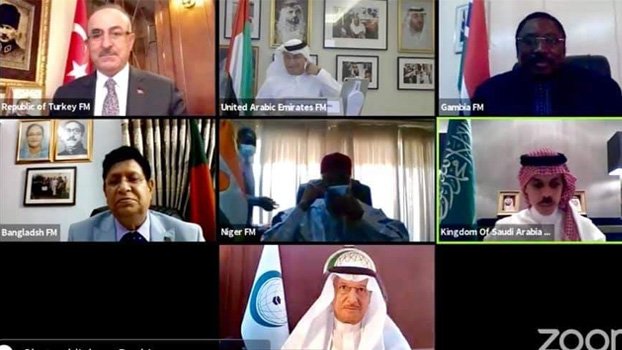
Bangladesh on Wednesday shared a series of ideas for the Organization of Islamic Cooperation (OIC) to help 57 member states overcome the coronavirus impacts with immediate, medium and long-term measures.
“The OIC must adopt a holistic and inclusive approach in designing tools to address the crisis,” Foreign Minister Dr AK Abdul Momen said at an urgent video conference meeting of the OIC Executive Committee.
Bangladesh, Turkey, Saudi Arabia, Gambia, United Arab Emirates, and Niger are the present EC members of OIC.
The foreign minister said the Covid-19 outbreak has pushed the whole of our known world into an ‘uncharted territory’.
“But these are also times which have brought out some of the rarest opportunities to introspect and see our faultlines more clearly”.
He said the key priorities for all OIC Member States at this stage should focus on:
“First, Saving lives by allocating adequate medical facilities, equiptment, experts and resources;
“Second, Supporting livelihoods and providing life-saving food supports in tackling hunger amongst the most vulnerable groups, and third, Getting economic activities back on foot as quickly as possible.”
He said while providing medical care and allocating related resources, “we must pay special attention so that the marginal and disadvantageous groups of the society are equally benefitted.”
“Due to prevailing working and living conditions, resident migrant workers are more exposed to the virus. Additionally, they are also susceptible to the economic meltdown being under threats of loosing jobs, which will need special attention to mitigate the sudden shock of unemployment,” Dr Momen said.
“We will require collective resolve and actions from the Members States to take care of the well-being of Muslim refugees around the globe, through allocation of adequate resources amidst this humanitarian crisis.”
He thanked the Custodian of Two Holy Mosques King Salman bin Abdulaziz Al Saud for his generous decision for providing free healthcare services to all COVID-19 patients irrespective of their residency status.
“In the same vein I express sincere appreciation for other leaders of the OIC Member States who have extended similar generosity.”
To overcome the challenges of this pandemic, the OIC Member States require a regional and global response based on ‘unity, solidarity and compassion’, he said.
Intensified global and regional cooperation is needed not only to contain, mitigate and defeat the pandemic but also to overcome the economic hurdles left by this crisis.
He suggested immediate, mid-term and long-term measures.
For immediate response, he said more developed Member States of the OIC may assist the LDCs and other developing OIC member states by supplying medical equipments and supplies in treating the COVID-19 patients.
“Steady distribution of food and essential commodities amongst the most vulnerable groups, irrespective of their residency status, are of utmost importance now to protect lives.
“If the lockdown situation prolongs, starvation is imminent in many of the OIC Member States, including amongst the migrant workers who are under threat of loosing their jobs and salaries.
“Charity and philanthropic organizations in OIC Member States may be encouraged to extend assistances in countries and communities in need.
Islamic Development Bank (IsDB) can actively consider deferral and cancellation of loan payments of the OIC borrowing countries especially from the LDCs.
“A voluntary COVID-19 Response and Recovery Fund may be created by the willing OIC Member Countries, independent of the efforts put in place by the IsDB and Islamic Solidary Fund (ISF).
“Suitable projects may be submitted, particularly by LDCs in collaboration with charities/foundations, to seek assistance from the special account created under the ISF to help the vulnerable groups, including migrant workers - if they are not covered under the safety net programmes of the host governments,” he said.
For medium to long-term measures, he said long term assistance would be needed to revive the economic devastation caused by COVID 19.
In this regard, he thanked the IsDB for already laying out $ 2.3 billion funding for Strategic Preparedness and Response Programme for COVID-19 pandemic.
“We hope, IsDB would allow softer terms for such laons, particularly for LDCs. Measures encouraging boost of intra-OIC trade to help economic recovery.
“G20 has pledged $7 trillion package for revival of the global economy and also committed to helping the developing countries as well.
“As G20 Chair, Saudi Arabia may help OIC member states, particularly LDCs and resources constraint developing countries, to avail necessary assistance from that economic package.
“Bilateral and Multilateral donors/lenders including WB, IMF may be requested through UN Mechanism to write off the debts/defer debt payments for a few years.
“The General Secretariat and its organs can take initiative to connect the research organizations in the field of medical sciences and medical equipment and also to incorporate the business bodies of the member states to facilitate bulk production of the required medical items,” Dr Momen said.
“The member states need to provide utmost importance on the issue of job retention of domestic and resident migrant workers - especially Muslim migrant workers - so that sudden shock of unemployment can be cushioned and the social balance can be preserved.
“Perhaps, we may engage new and innovative tools to strengthen SMEs in the migrant hosting countries –, which would offer win-win benefits for all.
“The humanitarian organizations in Member states may be provided with sufficient financial assistance, medical support to the Muslim migrant workers from LDCs and developing countries until the impact of the epidemic is over and also to advocate for their job retention to ensure their healthy livelihoods,” he said.
“Any response and recovery plan would require critical food security and agriculture value chain development.
“In this regard, I am happy to announce that Bangladesh readily agreed to establish the Regional Centre of Excellence for Rice, as proposed under the Islamic Organization for Food Security, to share its best practices,” the foreign minister said.
“We may consider creating a global network of interoperable agricultural commodity markets across the OIC (under the Islamic Organization for Food Security –IOFS) - so that our farmers and allied businesses are connected and cushioned against a possible financial meltdown of a global nature.
“Collective actions of members states would be necessary to look after the well-being of Muslim refugees around the globe through adequate resource allocation amidst this pandemic crisis.
“And finally, for better coordination of all our efforts, we need to have a Coordination Mechanism established within the General Secretariat, engaging the Committee of the Permanent Representatives.”
He said this pandemic has shaken the world and has shown how vulnerable our health system is, especially in the LDCs.
“However, I believe, addressing this global challenge in unity and solidarity by the OIC Member States and the global community will make us resilient and inspire us to work towards the greater well-being of our peoples,” he said.