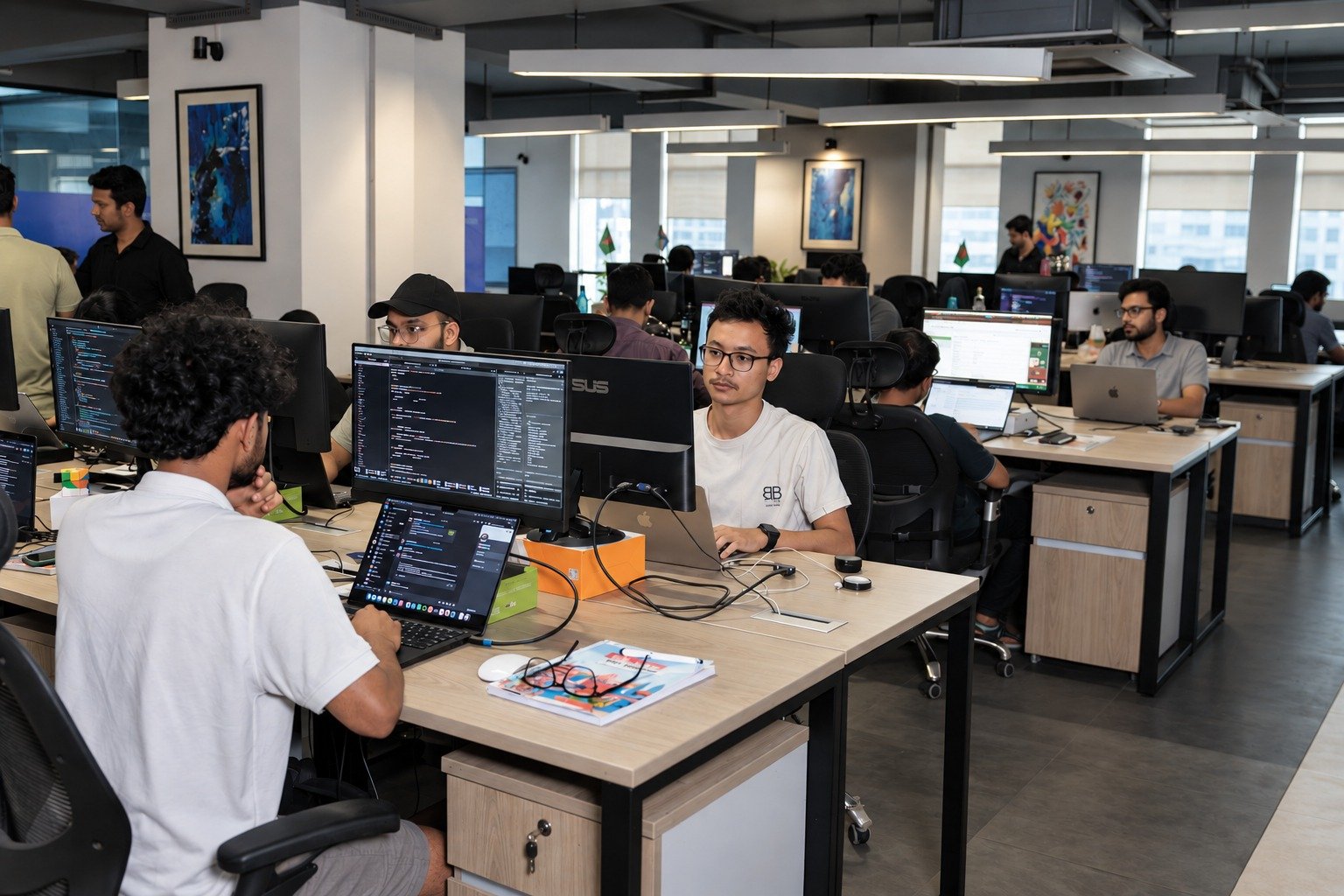
Bangladesh's software industry is gradually moving beyond its early position as a low-cost outsourcing destination. The sector still depends heavily on software services, but companies are increasingly working in areas such as fintech, healthcare technology, cloud infrastructure, embedded systems, cybersecurity and enterprise software.
The industry's next phase will depend on whether companies can turn this growing capacity into more specialized and higher-value technology work.
ICT market size and software exports
Bangladesh's information and communication technology market was valued at about $8.82 billion in 2025 and is projected to reach $9.44 billion in 2026, according to Mordor Intelligence. The market, which includes hardware, software, IT services and telecom, could reach $12.79 billion by 2031.
Software and IT-enabled service exports remain much smaller. The Export Promotion Bureau recorded $724.6 million in IT and ITES exports in FY2024-25, well below the government's earlier $5 billion target.
Some industry estimates put the figure as high as $1.6 billion. Former BASIS president Habibullah Neyamul Karim told The Business Standard that official data may understate the market because earnings from freelancers and smaller firms are not always reflected in formal export statistics.
Domestic demand for specialized services
While exports remain important, domestic demand is creating more opportunities for specialized software services.
The Bangladesh Investment Development Authority projects the domestic IT services market to grow by 11.8 percent annually between 2025 and 2029, reaching $3.29 billion.
Banking, financial services, and insurance accounted for about 21.56 percent of ICT spending in 2025. Core banking modernization, Islamic fintech growth and tighter cybersecurity requirements are increasing demand for more complex software systems.
Healthcare is another growing technology market, projected to expand at 8.13 percent annually. The Digital Health Strategy 2026-2032 and a requirement to digitize public hospital patient records by December 2027 are expected to increase demand for health technology services.
The Smart Bangladesh 2041 vision and the Cyber Security Act 2023 have also increased the focus on cloud infrastructure, data security and regulatory compliance.
Companies and workforce
The industry's ability to move into more specialized work depends largely on its workforce. BASIS had more than 2,700 member companies as of 2026, while some estimates put the total number of registered software and ICT firms above 4,500. Employment estimates range from about 300,000 to 500,000 IT professionals.
Bangladesh produces more than 50,000 computer science and engineering graduates annually. However, a 2018 Asian Development Bank study and more recent industry discussions have pointed to a gap between university education and the practical skills employers require, a challenge that becomes more significant as companies move into specialized fields.
Government support and infrastructure
Government policy is also beginning to support that transition. Software exports received a 6 percent cash incentive through December 2025, while companies operating in government-managed Hi-Tech Parks receive tax benefits.
Bangladesh permits 100 percent foreign ownership of ICT companies. According to BIDA, more than 350 Bangladeshi firms export to over 80 countries, while more than 40 foreign-owned or joint-venture development centers operate in the country.
Infrastructure is also improving. The National Data Center introduced GPU cloud and platform-as-a-service infrastructure in January 2026, giving local firms domestic computing capacity for data-intensive and AI-related work that previously often depended on overseas infrastructure.
These investments are important if Bangladesh wants to compete on technical capability rather than lower development costs alone.
Leading software companies in Bangladesh
The changing market is also visible in the work of some of Bangladesh's established software companies.
Vivasoft Limited serves 50+ international clients across sectors including AdTech, FinTech, health tech, telecom and gaming. Its R&D Lab has expanded into embedded systems and IoT, alongside a growing international presence through affiliated companies in Nepal, the UK and Malaysia.
REVE Systems has built a global telecom software business serving more than 4,500 operators across 78 countries, while BJIT specializes in engineering for Japanese companies. Cefalo and SELISE use Bangladesh as an engineering base for European clients. TigerIT has developed expertise in biometric and identity systems, while Brain Station 23 operates across more than 25 markets.
Together, these Bangladeshi leading software companies illustrate how the industry is moving beyond traditional outsourcing into more specialized technology services.
Freelancing and the wider technology workforce
Freelancing remains another major part of the industry. The ICT Division estimates around 650,000 active freelancers, while some independent estimates range from 800,000 to one million. They earn more than $500 million annually in foreign exchange, according to government and industry data.
Bangladesh has been ranked as the world's second-largest supplier of online labor in some studies, behind India.
In January 2026, the government launched the Freelancer ID platform to give freelancers formal recognition and improve access to banking and loans.
The freelance economy gives Bangladesh scale, but the next challenge is whether more of this workforce can move into specialized, higher-value technical work rather than competing mainly on cost.
Industry outlook
Bangladesh's software industry still faces significant challenges. Exports remain below earlier government ambitions, skills gaps persist, and differences between official and industry estimates make the sector difficult to measure.
But rising domestic demand, improving infrastructure and growing specialization suggest the industry's competitive position is changing. Its next phase will depend on whether companies can translate a large technology workforce into deeper expertise, higher-value exports and internationally competitive products.