Ahammad Parvej Khan
Highly toxic additives named phthalates and bisphenols known for causing serious health complications, have been found in plastic products across Bangladesh, according to a study report.
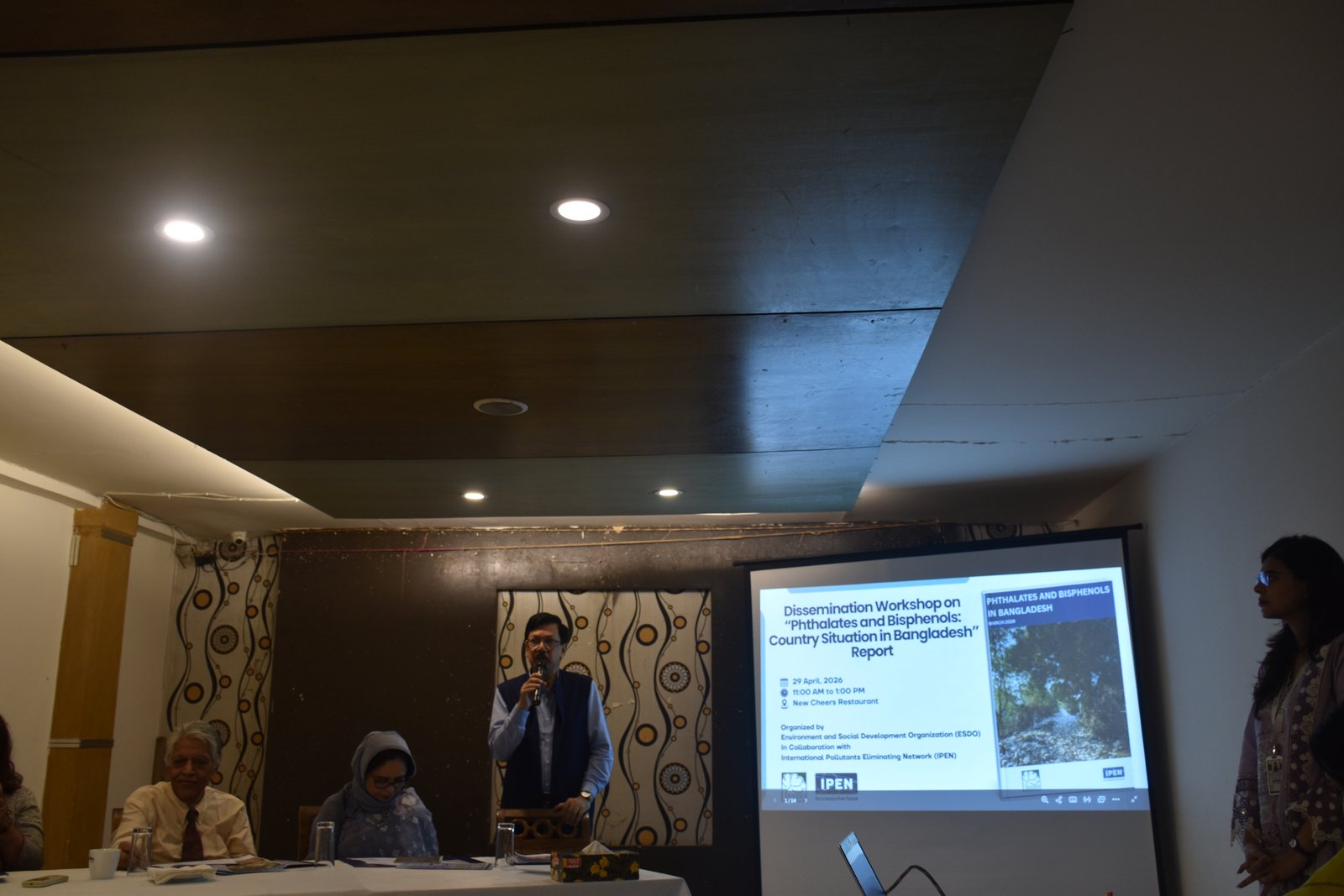
The Environment and Social Development Organization- ESDO on Wednesday launched the report at a dissemination and country situation assessment event.
This study provides a comprehensive assessment of phthalates and bisphenols in Bangladesh, examining their production, import patterns, use in consumer products, exposure pathways, and associated health and environmental risks.
The study was conducted by the Environment and Social Development Organization (ESDO) as part of a global initiative led by IPEN, which spans 19 countries.
The study report mentions that currently, Bangladesh produces over 3 million metric tons of plastic annually, with a domestic market valued at more than USD 3 billion and an annual growth rate of approximately 20%. Despite this rapid expansion, the focus of public and policy discussions has largely remained on visible plastic pollution, such as waste management and environmental contamination.
However, a critical but underexplored issue is the chemical composition of plastics, particularly the use of hazardous additives such as phthalates and bisphenols as plasticizer.
This report was developed using a mixed-method approach, combining quantitative data analysis with qualitative policy review and stakeholder insights. These chemicals are widely used as plasticizers and stabilizers to enhance flexibility, durability, and performance of plastic products.
However, they are globally recognized as endocrine-disrupting chemicals (EDCs), capable of interfering with hormonal systems. Scientific evidence links these substances to a wide range of adverse health outcomes, including reproductive disorders, developmental abnormalities, metabolic diseases, and cancers.
Bangladesh’s plastics industry is characterized by strong growth but heavy reliance on imported raw materials and chemical additives. The country imports approximately 750,000 tonnes of raw polymers annually, including polyethylene, polypropylene, and PVC, primarily from China, India, Saudi Arabia, and South Korea .
In addition to base polymers, significant quantities of chemical additives are imported:
Approximately 10,800 tonnes of phthalic anhydride were imported in 2020, 332 shipments of Dibutyl Phthalate (DBP) have been recorded and around 15 shipments of Bisphenol A (BPA) were imported in 2025
These chemicals are widely used across multiple sectors, including Food packaging and plastic containers, Children’s toys and school supplies, Thermal paper receipts, Flexible PVC products and Adhesives, coatings, and printing inks
The absence of mandatory chemical disclosure requirements means that these substances are used extensively without transparency, contributing to continuous and largely invisible exposure among the population.
The report identifies several population groups that are particularly vulnerable to exposure:
Children, due to frequent contact with toys and school supplies, Women, especially in relation to hormonal and reproductive health impacts, Retail workers, due to continuous handling of BPA-containing receipts and Communities in industrial areas, exposed through polluted water, air, and food
Bangladesh has initiated several policy measures addressing plastics and chemical safety; however, these efforts remain fragmented, partial, and largely product-specific
Chairperson of ESDO and former Secretary of the Government of Bangladesh highlighted, “This report should serve as a wake-up call for policymakers. Bangladesh now has an opportunity to build a modern regulatory framework that safeguards health while supporting responsible industrial development.”
Secretary General of ESDO, Dr. Shahriar Hossain, highlighted, “Bangladesh’s plastics sector is growing rapidly, but chemical safety governance has not kept pace. Without urgent action, hazardous additives will continue to threaten public health, workers, and the environment.”
Executive Director of ESDO, Siddika Sultana, explained, “Consumers have the right to know what chemicals are present in the products they use every day. Mandatory disclosure and stronger accountability are essential to protect families and future generations.”
Professor Dr. Mostafizur Rahman, Department of Environmental Science, Jahangirnagar University emphasized, “We are channeling all our attention towards what we are exporting, not what we are importing. This shows that we are working towards conserving the standard of the world but not ourselves”
Maksuda Khanom, Deputy Chief Chemist, BCIC, informed,” Currently, 29 ministries are working together to create a comprehensive Chemical Security Act under the guidance of the Ministry of Industries. Once that is sealed, we will be looking at a brighter future”.
Although Bangladesh has introduced several policy measures related to plastics and chemical safety, the report finds these initiatives remain fragmented, partial, and largely product-specific.
BSTI have been working on making a mandatory standard for Phthalates in toys and BFSA has previously worked on a draft without visible progress.
A comprehensive chemical regulation, stronger enforcement mechanisms, safer alternatives, and improved public awareness is warranted.