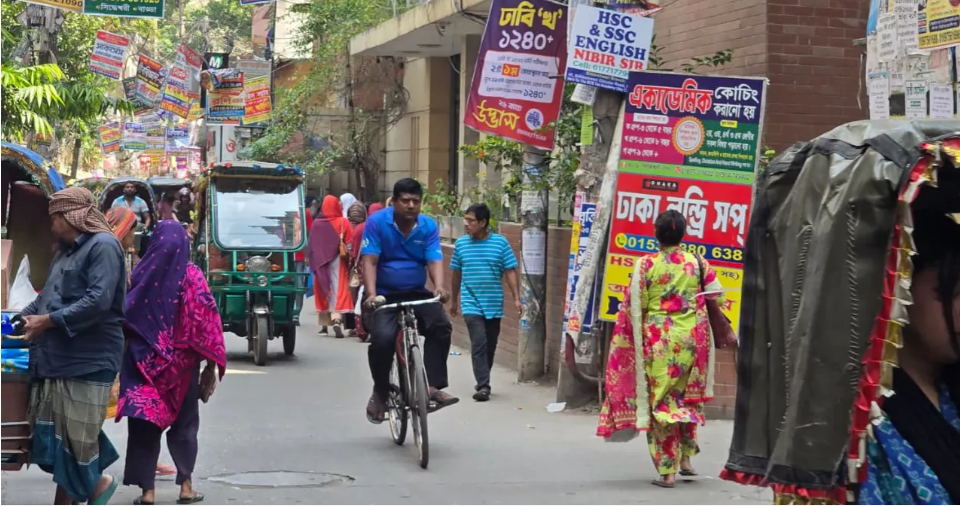
Since 2009, every Education Minister in Bangladesh has issued orders to shut down coaching centres. The count of those orders exceeds ten. The count of coaching centres permanently closed as a result is zero. The Education Act that could provide a legal basis for enforcement has been in draft for fifteen years. This article traces that record, corrects a widely circulated factual error, and identifies the structural reasons the policy has never worked.
The Chronology
Twenty-five years of shifting leadership, yet the "coaching center question" remains a permanent, unresolved loop on the ministerial agenda. Photo: UNB
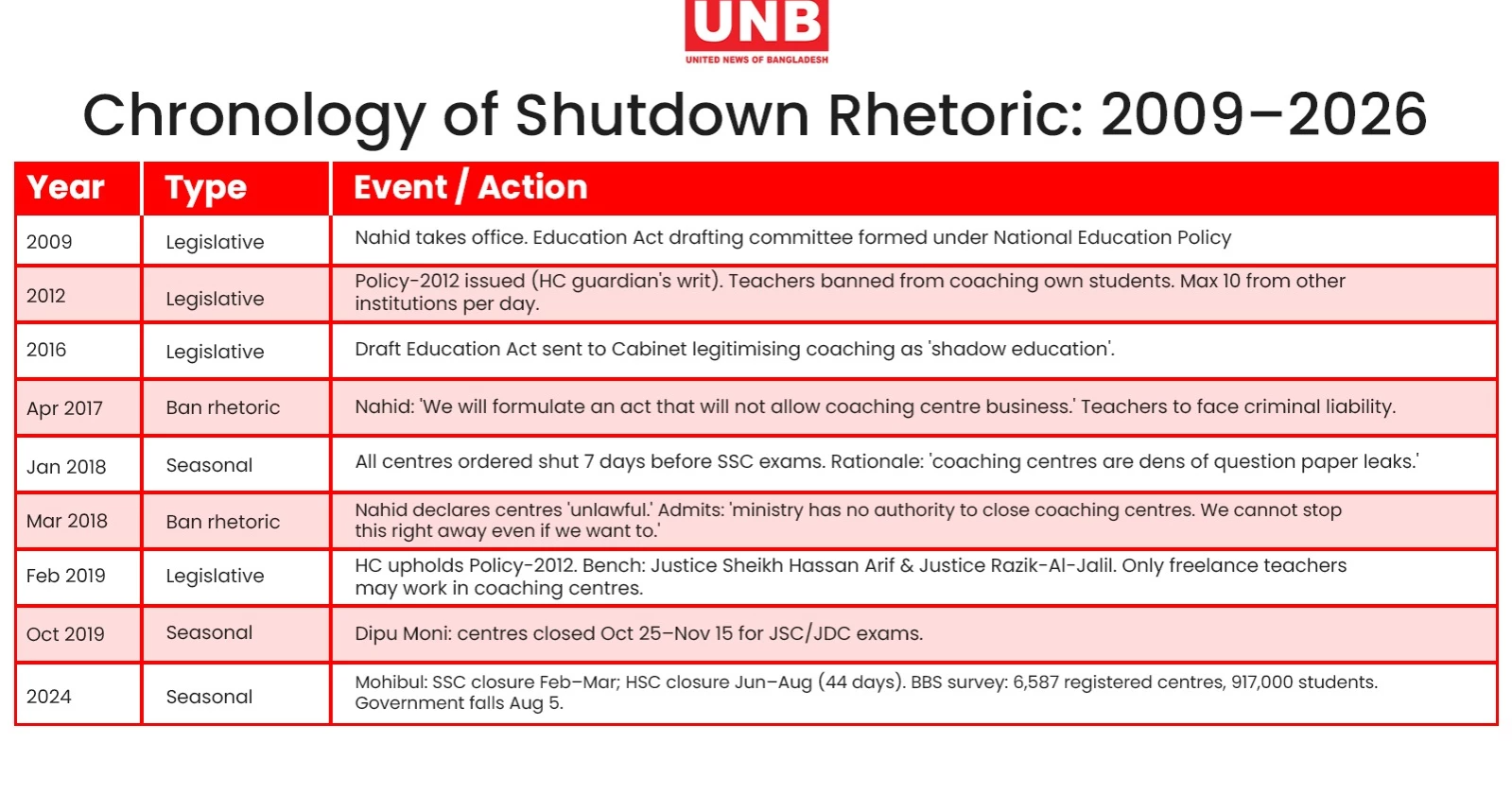
June 2012. Following a writ petition by Ziaul Kabir Dulu, president of the Ideal School Guardians' Forum, whose child attended Dhaka Ideal School and College the High Court directed the government to formulate guidelines. The result was the Coaching Business Ban Policy-2012 (Shikkha Protishthaner Shikkhokder Coaching Banijjya Bondho Neetimala-2012). It prohibited teachers from coaching their own students and capped coaching of students from other institutions at ten per day, with written permission from the teacher's institution head. The policy was ignored at the field level. Upazila-level officers waited for senior instruction rather than enforcing what was already a standing policy.
2012–2018. Three sets of writ petitions challenged Policy-2012: from teachers at Motijheel Govt Boys' High School, Dhanmondi Govt High School, and Viqarunnisa Noon School teacher Dr Farhana Khanam. The policy was under legal challenge for six years.
2016. A draft Education Act was sent to Cabinet that would have formally recognised coaching as "shadow education." The Cabinet returned it with objections. It was not enacted.
April 2017. Nahid announced that a new Act would be formulated to ban coaching centres entirely, with criminal liability for teachers involved. No draft was finalised.
January 2018. All coaching centres were ordered shut seven days before the SSC exams begin. The stated reason: coaching centres were being used to circulate leaked question papers.
February 2018. During the same SSC exam period, with question paper leaks continuing, Nahid publicly admitted the ministry had failed: "We are yet to dig deep into the root cause of the question leak. That is not in our hand." The Education Secretary separately stated that a law to ban coaching centres was being prepared.
March 2018. Ahead of HSC season, Nahid held a press conference at which he declared all coaching centres unlawful and simultaneously acknowledged he could not close them. His statement on record: "The law does not allow any coaching centre to operate in Bangladesh. Even then, many crimes are happening in our country. We cannot stop all these right away even if we want to." He had been minister for nine years. No closures resulted.
February 7, 2019. The High Court bench of Justice Sheikh Hasan Arif and Justice Razik-Al-Jalil upheld Policy-2012 in full, ruling it constitutional after hearing five separate petitions. The court held that teachers of government and private educational institutions could not be involved in coaching businesses; only "freelance" teachers not employed at any institution could legally teach in coaching centres. The ACC was confirmed as the authority to investigate government school teachers who defied the ban.
February 10–11, 2019. A RAB mobile court led by Executive Magistrate Sarwoer Alam sealed six coaching centres in Dhaka: Moby Dick, Nabadiganta Academy, Joy Jatra, Onanya Dreams, Creatives, and Blaze. Eight persons were sentenced to one month in jail each. Owners had been operating with "Closed" signs on the main gate while conducting classes inside. The raid covered Farmgate and surrounding areas. The majority of centres, including those in Arambagh, continued operating uninterrupted.
October 2019. Minister Dipu Moni ordered centres closed from October 25 to November 15 for JSC/JDC exams. New Age reported that centres in Arambagh and Old Dhaka were openly defying the order and continuing classes.
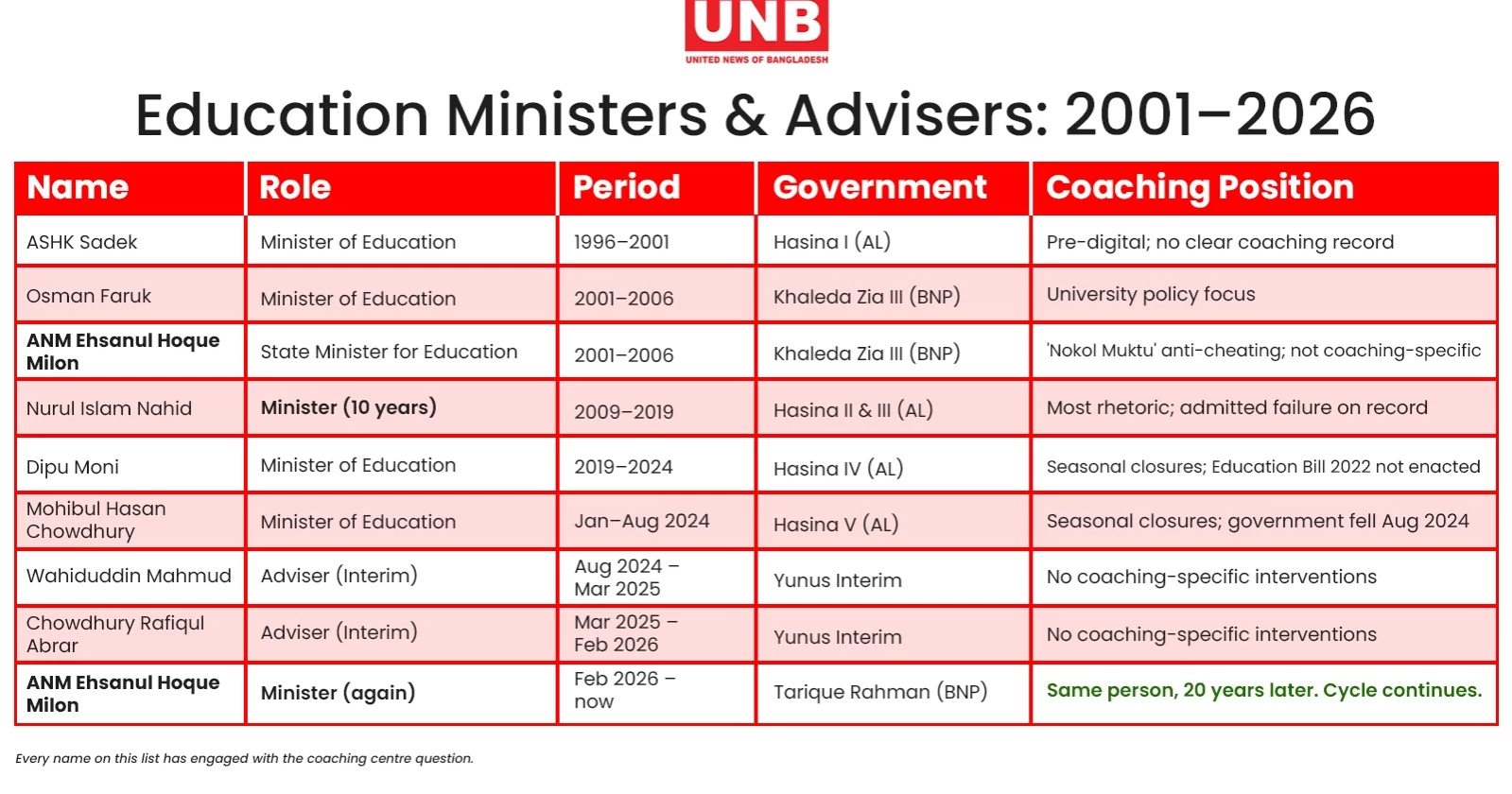
2020–2022. Dipu Moni continued the seasonal closure pattern for SSC and HSC exam periods, with documented non-compliance and no enforcement actions. In 2022, an Education Bill that would have permitted coaching outside school hours was sent to Cabinet. It was never tabled in Parliament and died at the Cabinet stage.
2024. Minister Mohibul Hasan Chowdhury ordered SSC closures from February 13 to March 12, and HSC closures from June 29 to August 11 44 days in total. The Bangladesh Bureau of Statistics Private Educational Institutions Survey 2024 recorded 6,587 registered coaching centres serving 917,000 students, employing 66,754 staff including 61,812 teachers. The Hasina government fell on August 5, 2024.
August 2024 – February 2026. The Yunus-led interim government's two Education Advisers Wahiduddin Mahmud (August 2024 – March 2025) and Chowdhury Rafiqul Abrar (March 2025 – February 2026) made no coaching-specific policy interventions.
February 2026. Following the BNP's general election victory, ANM Ehsanul Hoque Milon was appointed Education and Primary and Mass Education Minister. He previously served as State Minister for Education from 2001 to 2006 under Khaleda Zia. He has announced a 180-day priority programme for the sector.
The Market Data
According to the BBS(Bangladesh Bureau of Statistics) Private Educational Institutions Survey 2024, Bangladesh has 6,587 registered coaching centres: 6,312 academic, 275 providing university admission or job preparation coaching. These serve 917,000 students and employ 61,812 teachers, with an additional 26,970 part-time workers. The 6,587 figure covers registered centres only. Bonik Barta's September 2025 investigation found that unregistered centres substantially outnumber registered ones in Chattogram alone; a city corporation survey identified 401 coaching centres, of which only 120 held valid registration.
On market size: estimates vary across sources. Future Startup's 2024 education market analysis and the Education Research Council both cite the offline coaching market at approximately ৳25,000 crore. Other figures in circulation from a professor cited in Dhaka Tribune in 2018, and from the NGO Education Communication range from ৳32,000 to ৳50,000 crore. The ৳25,000 crore figure is the conservative end of the documented range.
On family spending: the government-sponsored Education Household Survey 2014 found that 29 percent of all family education expenditure goes to coaching and private tuition, the single largest share of education spending. The same survey found parents spending three times more on coaching fees than on school tuition fees.
Why the Policy Has Not Worked
Regulatory mismatch. Coaching centres register under local government bodies, city corporations, municipalities, union parishads, not the Ministry of Education. As Bonik Barta confirmed in September 2025, this leaves the Ministry with no direct licensing or inspection authority over them in ordinary times. Shutdown orders are instructions the Ministry has no mechanism to enforce.
Teacher incentive structure. Public school teacher salaries are insufficient relative to urban living costs. Coaching income is a primary supplement for most teachers. Policy-2012 implicitly acknowledged this by setting a limit rather than an outright ban but the limit had no enforcement mechanism. As Dhaka Tribune's 2024 investigation found, over a decade after the policy was issued, its implementation rate was effectively zero at the field level.
Demand driven by school quality. According to the World Bank, Bangladesh's learning poverty rate stands at 57 percent — more than half of primary-aged children cannot read a simple text at grade level. A separate 2022 National Student Assessment found 70 percent of fifth graders lack maths proficiency at grade level.
The exam-leak diagnosis was wrong. Seasonal closures were justified on the grounds that coaching centres enabled question paper leaks. Nahid admitted on record in February 2018 that the leak problem was not in the buildings but in networks of individual teachers, many of whom were also coaching operators. A spatial ban cannot close a social network.
The Education Act has never been enacted. The Act has been in draft since 2011 across multiple governments, with each draft taking a different position: the 2016 version legitimised coaching as "shadow education," the 2017 version banned it with criminal penalties, the 2022 version allowed it outside school hours. Parliament has seen none of these versions. After fifteen years, there is still no legislative basis for permanent closures and no enforcement infrastructure that could be built on one.
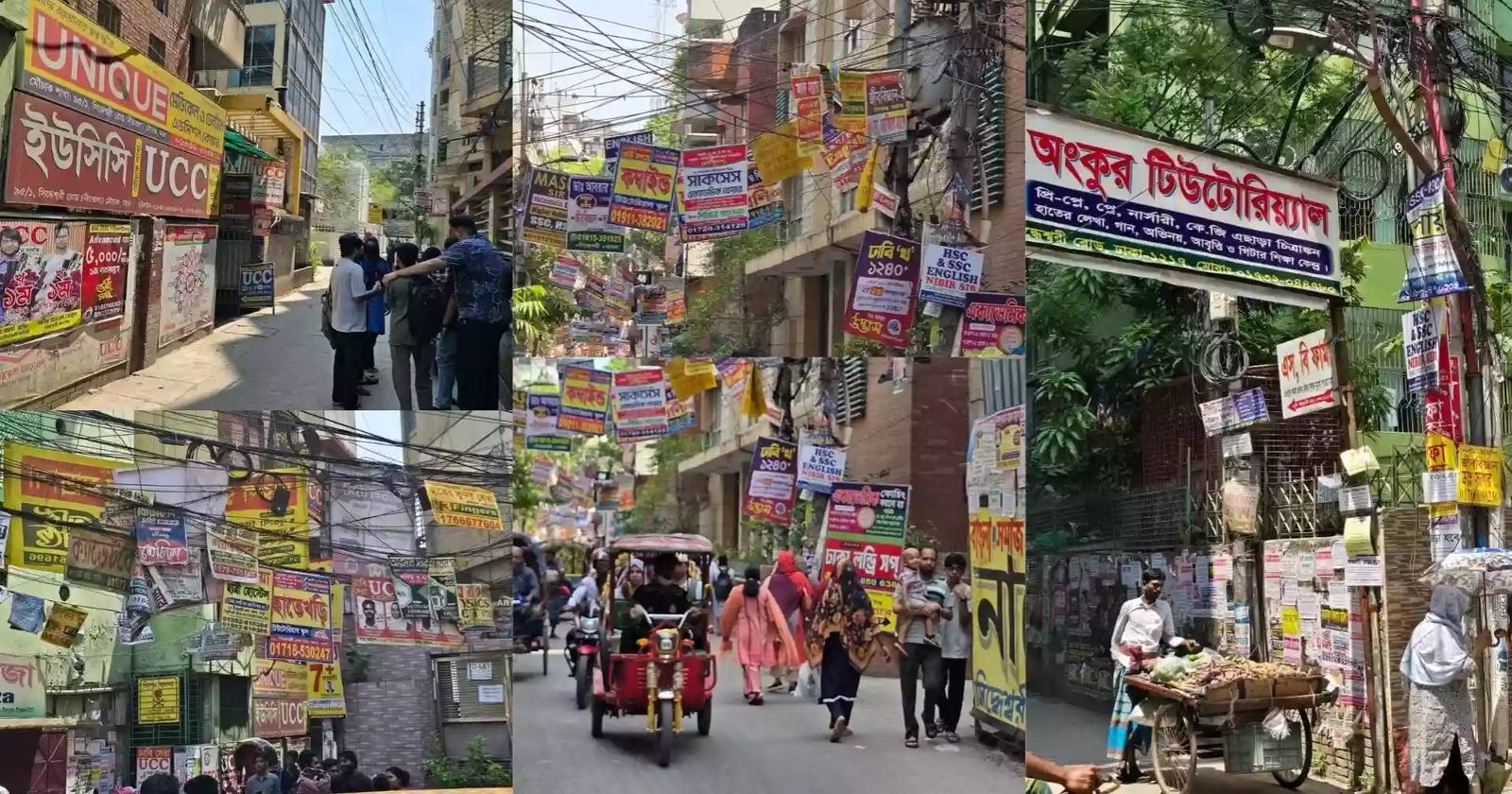
Despite decades of regulatory attempts, the coaching industry remains the most visible face of Bangladesh’s education sector.Photo: Md Arman Hossen/UNB
Every Education Minister since 2009 issued seasonal shutdown orders. Not one succeeded in keeping centres closed even for the duration of an exam period. The High Court validated the policy in 2019 and no enforcement mechanism was created afterward. The coaching sector grew through every order. The Education Act remains unenacted. The current minister held the same post twenty years ago. Nothing in the structural picture regulatory authority, teacher pay, school quality, or legislation has changed in a way that would produce a different outcome from the next round of orders.