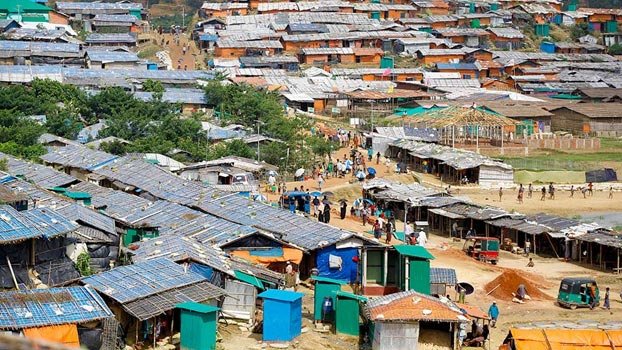
Bangladesh on Monday rejected any notion of local integration of forcibly displaced Rohingya people of Myanmar in Cox’s Bazar.
Foreign Secretary Masud Bin Momen also clarified that the government would not prefer any investments “which will directly or indirectly prolong the refugee situation and create greater and newer pull factors for remaining Rohingyas inside Rakhine”.
“Bangladesh government rejects any notion of local integration,” he said, speaking at a webinar organised by the Center for Peace Studies (CPS) of the South Asian Institute of Policy and Governance (SIPG) at the North South University in Dhaka.
The seminar titled ‘The Rohingya Crisis: Western, Asian and Bilateral Perspectives’ was organised on the occasion of the third year of the latest influx of minority Rohingya people of Myanmar to Bangladesh since 25 August 2017.
Experts from home and abroad participated in the discussion chaired by North South University Vice Chancellor Professor Atiqul Islam.
Marking the day, the UNHCR, the UN Refugee Agency, is calling for renewed support and solutions for displaced and stateless Rohingya communities both within and outside of Myanmar today.
The foreign secretary highlighted different measures taken by the Bangladesh government for Rohingyas safety and security in the camps.
He said the government is working on extending educational facilities for Rohingya children from grade six to nine in Myanmar curriculum and skills training for young members of the community so that they can maintain livelihood after returning to their ancestral home in Rakhine at the earliest.
At present, over 3,200 Learning Centres are in operation on a curriculum called Learning Competency Framework and Approach (LCFA).
“Based on demands for further education for children and youth, we have decided to ensure access of Rohingya children according to Myanmar curriculum,” he said.
Rohingyas have been demanding secondary level education in the camps in Myanmar curriculum, with a graded system and certification process for easy reintegration into Myanmar Schools after repatriation.
The Myanmar Curriculum Pilot has thus been adopted under the Joint Response Plan.
“We hope to see its operationalisation soon at the middle school (grades 6-9) level. We expect that the UN agencies would soon develop skill development programs for the Rohingya youth and locals in consultation with our authorities.
“There could be other kinds of improvement of short-term amenities and facilities if we have adequate support from the international partners,” he said.
“However, I must clarify here that we would certainly not prefer investments which will directly or indirectly prolong the refugee situation and create greater and newer pull factors for remaining Rohingyas inside Rakhine.
“Bangladesh government rejects any notion of local integration,” the foreign secretary said.
“We would expect interested partners to talk to the Myanmar government and make such long-term investments on health, education, livelihood, connectivity for Rohingyas in northern Rakhine.
“So far, we discern no such efforts for remaining Rohingyas inside Rakhine,” he said.
Former Foreign Minister of Malaysia Tan Sri Dr Syed Hamid Albar described Rohingya crisis a serious violation of human rights, genocide, and crime against humanity with implications the regional levels.
ASEAN, in which Myanmar is also a member, has not taken any meaningful step as there is a high level of tolerance and unwillingness to discuss the Rohingya crisis in ASEAN mechanisms, he said.
US Ambassador to Bangladesh Earl R. Miller said his country would continue to press Burma, now Myanmar, to stop institutional persecution against minority communities.
High Commissioner of Canada to Bangladesh Benoit Préfontaine stressed the need for ensuring accountability in Myanmar for crimes committed against Rohingya people as well strengthening accountability efforts by the international community with, among others, sending a UN Security Council referral to the International Criminal Court and the International Court of Justice.
Former Foreign Secretary Mohammad Shahidul Haque, now a Senior Fellow of SIPG, said Bangladesh should consistently and coherently pursue “hybrid diplomacy” involving bilateral, regional and multilateral pathways anchored in accountability and justice for resolving the Rohingya crisis with ensuring sustainable repatriation of the members of the community to Myanmar.
North South University Vice Chancellor Professor Atiqul Islam said, in his remarks as chair of the session, resolving Rohingya crisis at the earliest is essential for peace and stability in the region.
Prof Sheikh Tawfique M. Haque, Director of SIPG also spoke in the discussion moderated by Dr Ishrat Zakia Sultana. Dr. M Jashim Uddin, Coordinator of CPS, gave a vote of thanks in the webinar.
Several members of the Rohingya community participated in the session and presented questions for the discussants on the need of education for the young people in camps in Cox’s Bazar.
Over 860,000 Rohingya people crossed the border with Bangladesh in the last influx that began on 25August 2017 amid atrocities committed by the Myanmar military and its extremist cohorts.
Bangladesh has been hosting more than 1.1 million Rohingya people for years as two attempts to launch the repatriation on the grounds failed since the signing of agreements with Myanmar about three years ago on sending them to their home in Rakhine.