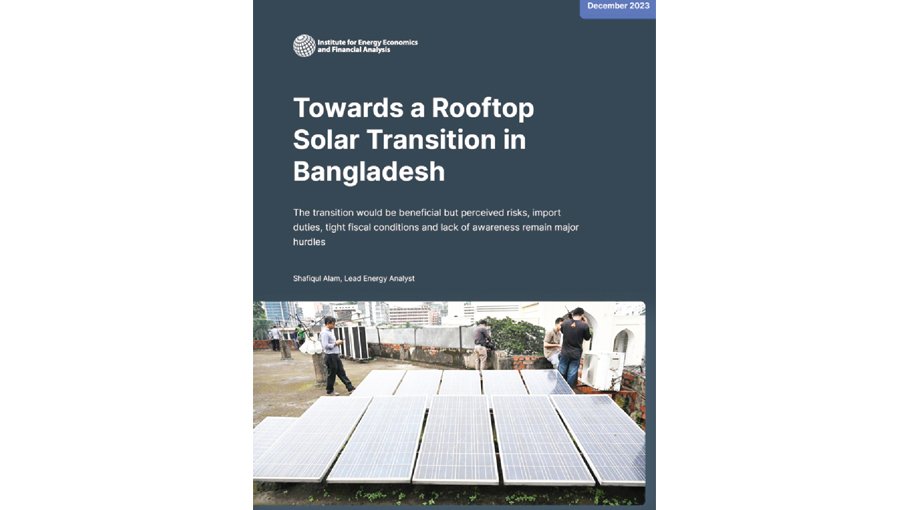
“Bangladesh needs to design a market that incentivises and de-risks investments in rooftop solar to promote it at a faster pace and scale. The policy and regulatory measures put in place will set the course of rooftop solar for years to come”, says a new study report of IEEFA titled “Towards a Rooftop Solar Transition in Bangladesh”.
Institute of Energy Economics and Financial Analysis (IEEFA), Lead Energy Analyst, Shafiqul Alam conducted the study.
The study identifies six key levers to address the hurdles facing rooftop solar in Bangladesh quickly and effectively. These are raising awareness, streamlining finance, policy and regulatory intervention, quality assurance, a business model for utilities and capacity development of major stakeholders. According to the study, the Rooftop solar capacity added in Bangladesh from 2012 to 2022 was paltry, with a lack of monitoring and quality control of solar equipment installed as part of obtaining new grid connections damaging confidence in the sector. Installations surged in 2023, momentum that needs to be accelerated through incentives for lenders, utilities and investors to support the sector.
“We estimate that rooftop solar expansion of just 2,000 megawatts (MW) capacity could save the Bangladesh Power Development Board up to US$1 billion a year by reducing generation and purchase of costly fossil fuel-based power”.
Yet the unlevel playing field created by import tariffs on rooftop solar equipment and perceived risks of lenders are major obstacles to the sector’s expansion. This is despite new tariffs on offer making a strong economic case and being more attractive than those that sparked the rooftop solar explosion in Vietnam in 2020.
However, many in Bangladesh remain unaware of the benefits and savings rooftop solar offers. A cohesive business model, risk mitigation instruments and capacity development can benefit stakeholders, consumers and the economy.
The rooftop solar segment is yet
to peak in Bangladesh. The frequent load-shedding and steep electricity bills have only created scattershot interest among industries and building owners.
As of 10 October 2023, the country had a combined rooftop solar capacity of only 160.63MW, including net-metered and non-net-metered systems.
Analysis of the sector shows that Bangladesh registered this meagre rooftop solar capacity addition over a period of more than 11 years with the first system installed on 1 July 2012 without the net metering.
However, there has been a positive trend lately, with the sector adding 42.04MW capacity in the first three quarters of 2023. Of this 42.04MW, rooftop solar under net metering made up 31.21MW.