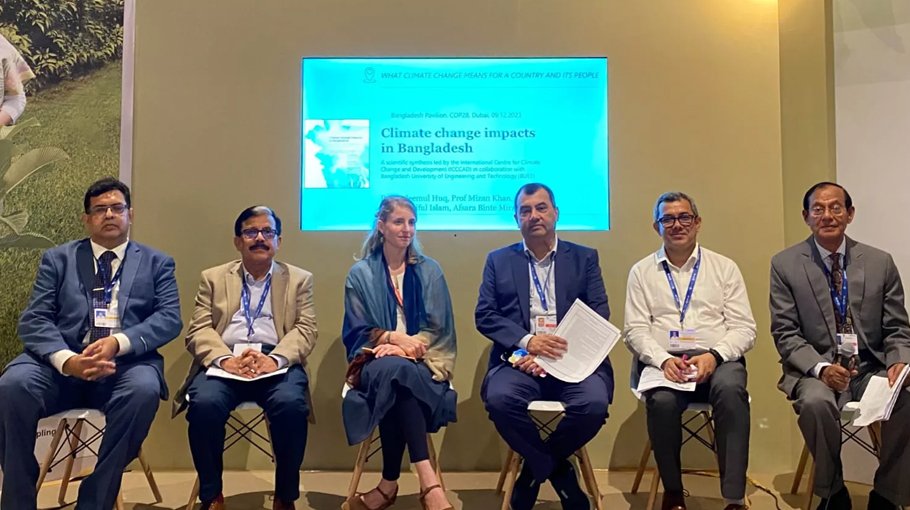
Despite commendable progress in climate resilience, Bangladesh is still grappling with loss and damage issues due to severe impacts of climate change.
The ongoing 2023 United Nations Climate Change Conference or COP28 that is taking place in Dubai of UAE has seen pledged more than USD 600 million for Loss and Damage Fund (LDF).
However, Bangladeshi experts and policymakers have showed concern over size and accessibility of the fund on one hand and the need for a functional and effective national loss and damage mechanism in the country.
They made the concern in an event held in Bangladesh Pavilion at COP28 in Dubai on Saturday.
Saber Hossain Chowdhury, MP, special envoy to Prime Minister of Bangladesh on Climate Change; spoke at the event. Md. Shamsuddoha, chief executive of Center for Participatory Research and Development (CPRD) and some other experts also attended the event.
Environment, Forest and Climate Change Minister Md Shahab Uddin, MP, also made comment on the issue.
Md Shahab Uddin said that governments through policy, regulation, and fostering unavoidable climate action play a central role to tackle climate crisis of Bangladesh. Collaborating hand in hand with the private sector,
encouraging renewable energy, eco-friendly tech adoption, and climate resilience will pave a path towards sustainability. Embracing resilience practices, international collaboration becomes imperative given the global nature of climate change, he added.
He further said that a multistakeholder strategy is vital. “Let us commit to principles of collaboration and shared responsibility, envisioning a world where impacts are mitigated, and our planet in harmony,” said the minister.
Saber Hossain Chowdhury said, “We are witnessing flooding, depletion of water sources, escalating sea levels, and the intrusion of salinity due to our country’s geographical position. Millions of people as well 1/7 of the population of the country might face displacement as per the World Bank’s estimation.”
He also said, “Acknowledging the very real impacts, we find solace in the establishment of a loss and damage mechanism at COP28. Reflecting on the UNFCCC’s responsiveness in decisions like Sharm El Sheikh, within 12 months, over 600 million USD has been allocated—an initial step, yet hopefully the beginning of greater contributions.”
Bangladesh aims to proactively access and efficiently utilize the fund, drawing upon its wealth of experience in adaptation. To address the loss and damage, it necessitates averting, minimizing, and addressing them through both adaptation and mitigation. It is not just about mitigating loss and damage; it is about preventing them from occurring in the first place. While some adaptations inevitably lead to loss and damage, the key is to ensure not all adaptations halt at this point, said Saber Hossain Chowdhury.
According to a report on the Bangladesh’s policy landscape on loss and damage published by the International Centre for Climate Change and Development (ICCCAD), Bangladesh has several national policies, including the National Adaptation Plan (NAP), Nationally Determined Contributions (NDC), and the Mujib Climate Prosperity Plan (MCPP), have set ambitious climate targets but face challenges in effectively addressing loss and damage.
The report emphasized the mobilization of fund from multi-actor partners, such as private sector, financial institutions, NGOs, and local organisations.
Experts in the event in Dubai mentioned that despite having dedicated climate funds like the Bangladesh Climate Change Trust (BCCT), challenges still persist, such as limited funding, coordination issues, and inadequate transparency mechanisms affect their utilization. So, it is important to develop the National Mechanism for loss and damage to have a window for L&D funds with improved transparency and accountability structures.
Md. Shamsuddoha said that the establishment of Loss and Damage Fund (LDF) at COP28 reflects the global unjust power dynamics and knowledge hegemony from developed countries.
He also said, “We welcome the national mechanism, but it requires inclusive institutions and governance. Expanding the Loss and Damage fund’s mandate is essential, involving different government entities such as: Planning Commission, Ministry of Finance, Ministry of Women and Children Affairs (MoWCA). Justice at the national level must be ensured and addressing the governance gaps globally to preventdebt burden for countries like Bangladesh is important.”