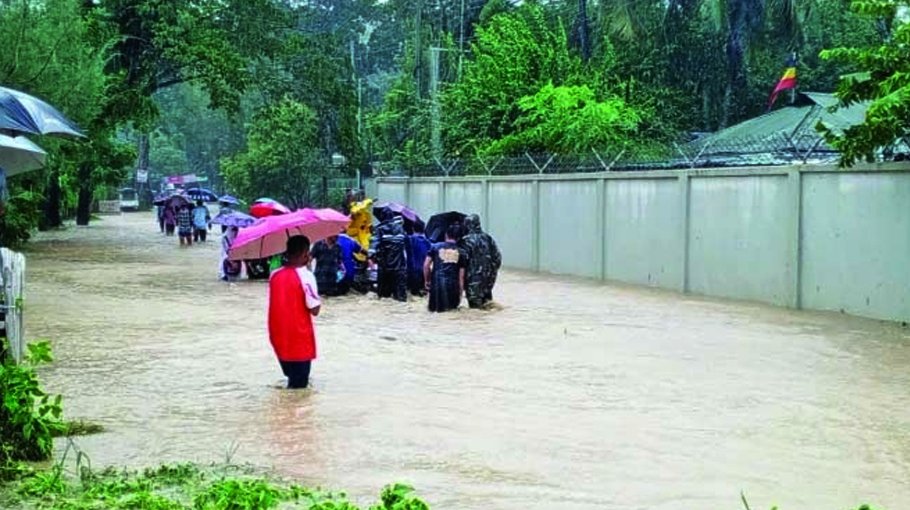
Approximately 55-60 percent of Bangladesh is submerged by floods annually, with a projected surge of 36 per cent in peak river flow by 2070 under a high-emissions scenario.
Against this backdrop, over half of the population of the country is exposed to high flood risks, leading to grave humanitarian, economic, and environmental consequences, says a global research report.
The Grantham Research Institute on Climate Change and the Environment and Centre for Climate Change Economics, a London-based research and training institute on climate change and environment, carried out the research, the findings of which have been published recently.
The research report says that the flood situation in Bangladesh has escalated dramatically due to the intensifying impacts of climate change. In such a situation, an urgent and comprehensive global response is a must to address the situation.
According to the research report, Bangladesh is sounding a clarion call to the world as it grapples with the convergence of two grave challenges, flooding and climate change.
The report, however, says that the 2022 floods in the country are estimated to have cost US$1.0 billion and affected 7.3 million people.
The report recommended a low-carbon pathway, comprehensive shift in policy making, moving away from fossil fuels, strengthening early warning systems for flood preparedness, increasing capacity within local institutions, and embracing nature-based solutions.
Professor Dr AKM Saiful Islam, director of Institute of Water and Flood Management of Bangladesh University of Engineering and Technology (BUET); said, “As we witness the escalating flood risk facing Bangladesh, recent events such as the devastating floods in Bandarban and Sylhet serve as stark reminders of the urgency of the situation. Climate change is intensifying the water cycle, which brings more intense rainfall and associated flooding.”
He also said, “The vulnerable state of our nation demands urgent action. It is imperative that we embark on a comprehensive energy transition while simultaneously fortifying our flood management and disaster preparedness strategies. The time for robust climate actions is now, as we work towards safeguarding our communities, livelihood, ecosystem, biodiversity, environment, and our future generations.”
The humanitarian and economic costs of flooding in Bangladesh are increasing further due to climate change. The mounting toll of floods is felt in lost lives and economic devastation.
The Chattogram region of the country, particularly Bandarban, had witnessed a devastating flood recently.
Umme Kulsum, a recent flood victim of Kalaghata in Bandarban said, “We have never experienced such flooding in our area before. The magnitude of our suffering knows no bounds and the urgency of our situation cannot be overstated. We completely remained helpless, full of misery and frightened.”
The Bangladesh Delta Plan 2100 (BDP 2100) lies at the forefront of the country’s resilience strategy. This ambitious plan seeks to integrate sector policies, foster equitable water governance, and enhance resilience against floods and climate change. Yet, challenges persist, including insufficient knowledge about vulnerabilities and local needs; a lack of capacity in local institutions such as the Ministry of Disaster Management and Relief; governance issues; and poor access to funding for investment in adaptation.
The research report highlighted that while Bangladesh contributes just 0.25% of global greenhouse gas emissions; its plight underscores the interconnectedness of climate action. The nation’s survival hinges on a concerted global effort to mitigate the impacts of climate change, especially from high-emitting industrial countries. Bangladesh must make efforts to fulfill its Nationally Determined Contribution (NDC) in support of the Paris Agreement.
However, the agriculture and energy sectors are responsible for most of the country’s emissions, contributing 44 per cent and 39 per cent respectively and are estimated to peak in 2040.
While Bangladesh has mitigation plans and commitments, its current and planned actions to reduce power sector emissions must be revised to put it on a pathway to decarbonise the energy system. Hence, the agricultural and energy sectors must undergo a transformation, prioritizing renewable energy sources to pave the way toward sustainability.
The report recommended a coordinated approach involving government bodies, NGOs, civil society organizations, the private sector, research institutions, and academia is pivotal for optimal flood response and disaster risk management.
Dr Saleemul Huq, director of the International Centre for Climate Change and Development (ICCCAD) said, “The need for immediate action is becoming more urgent as flood risks for Bangladesh increase due to the unrelenting force of climate change. The call of our time is for global cooperation, as we stand at the intersection of strong adaptation strategies and energy transition. It is also imperative to have adequate climate finance and take a firm stance against addressing loss and damage and create a world that overcomes adversity."
Bangladesh stands at this critical juncture, and it sends a fervent plea to the world. The path ahead is laden with challenges, but within those challenges lies the opportunity for innovation, collaboration, and the pursuit of a sustainable future. The window of opportunity is narrowing, and the world must now address the plight of a nation whose survival depends on our collective response to the climate crisis.