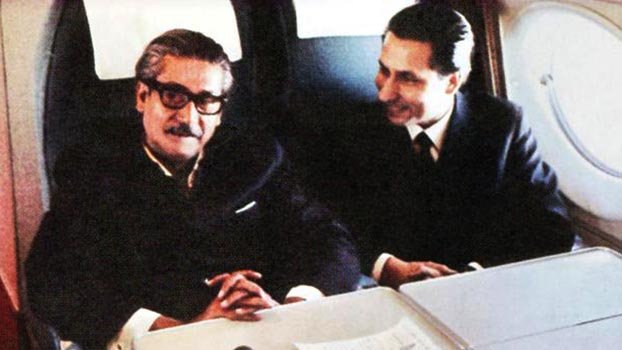
Upon assuming the presidency after Yahya Khan's resignation, Zulfikar Ali Bhutto responded to international pressure and released Mujib on 8 January 1972. After release from prison, Bhutto and Mujib met in Rawalpindi. In that meeting, Bhutto proposed some links between Pakistan and Bangladesh. However Mujib said he could not commit to anything until he visited Bangladesh and talked to his colleagues. He was then flown to London where he met with British Prime Minister Edward Heath and addressed the international media at the Claridge's Hotel. Mujib then flew to New Delhi on a Royal Air Force (RAF) jet aircraft provided by the British government to take him back to Dhaka.
In New Delhi, he was received by Indian President Varahagiri Venkata Giri and Prime Minister Indira Gandhi as well as the entire Indian cabinet and chiefs of armed forces. Delhi was given a festive look as Mujib and Indira addressed a huge crowd where he publicly expressed his gratitude to Indira Gandhi and "the best friends of my people, the people of India". "From New Delhi, Sheikh Mujib flew back to Dhaka on the RAF jet where he was received by a massive and emotional sea of people at Tejgaon Airport."
Bhutto drove to Islamabad Airport to see Mujib off for London aboard a chartered Pakistani jetliner on January 8th. To maintain the utmost secrecy, the flight left at 3 a.m. The secret departure was not announced to newsmen in Pakistan until ten hours later, just before the arrival of the Shah of Iran at the same airport for a six-hour visit with Bhutto. By that time Mujib had reached London—tired but seemingly in good health. "As you can see, I am very much alive and well," said Mujib, jauntily puffing on a brier pipe. "At this stage I only want to be seen and not heard."
A few hours later, however, after talking by telephone with India's Prime Minister Indira Gandhi in New Delhi and with the acting President of Bangladesh, Syed Nazrul Islam, in Dhaka, Mujib held a press conference in the ballroom of Claridge's Hotel. While scores of jubilant East Bengalis gathered outside the hotel, Mujib called for world recognition of Bangladesh, which he described as "an unchallengeable reality," and asked that it be admitted to the United Nations.
Clearly seething with rage, Mujib described his life "in a condemned cell in a desert area in the scorching heat," for nine months without news of his family or the outside world. He was ready to be executed, he said. "And a man who is ready to die, nobody can kill." —History