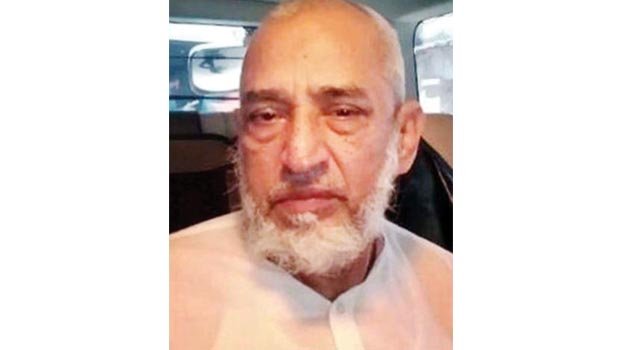
Sacked military captain Abdul Majed, one of the killers of Bangabandhu Sheikh Mujibur Rahman and his family members, has been executed, nearly 45 years after the assassination of the Father of the Nation on the darkest night of August 15 in 1975. Majed was hanged at the Dhaka Central Jail in Keraniganj, outskirt of the capital, a minute after midnight of Saturday, Inspector General of Prisons Brigadier General AKM Mustafa Kamal Pasha told Bangladesh Post.
Jailer Mahbubul Islam told that along with the IG (Prisons), Dhaka’s deputy commissioner, superintendent of police, civil surgeon, deputy inspector general of prisons and other officials concerned were present during the execution. Majed was the first person to be executed at the new Dhaka central jail after it was relocated to Keraniganj from the Old Dhaka.
Jail authorities handed over the body to the family after two and a half hour completing all formalities. However, people were seen throwing shoes at an ambulance carrying the body near the jail. Majed was buried at the family graveyard of in-laws' house in Hosenpur area in Narayanganj’s Sonargaon upazila on Sunday morning.
Family first decided to bury him at their village in Bhola. As the decision sparks protest among villagers, they then opted for his father’s-in laws house in Narayanganj. The burial of Majed in Sonargaon too drew anger among different the leaders and activists of different political and social organizations including ruling Awami League.
Locals gathered in front of the graveyard on the morning hearing the news, said Abdur Rouf, chairman of Shambhupur Union Parishad.
They also demanded the grave of Bangabandhu’s killer be relocated from Narayanganj. Freedom fighters and AL leaders along with locals would begin demonstration, if Majed’s grave is not relocated, Freedom fighter and upazila AL convener Saiful Islam Bhuiyan told Bangladesh Post.
Sonargaon Police Station officer-in-charge Inspector Moniruzzaman said Majed was buried in Narayanganj following the government order. He urged the protesters and ruling party leaders to reach out to authorities concerned to press their demand. “If anyone tries to create chaos police will take action,” he warned.
The time of execution of Majed was earlier set at 10:00pm on Saturday. But due to heavy storm, some officials concerned could not reach Keraniganj timely prompting the authorities to change the execution time. Before execution, Majed was handcuffed and his head was covered in black hood. Two hangmen put one noose around his neck. Chief Hangmen Mohammad Shajahan and his main assistant Monir and Siraj were ready to pull levers to slide apart the scaffolds.
Dhaka Jail Superintendent dropped a handkerchief from his hand to give signal to the hangmen at just 12:01am. The hangmen pulled the levers immediately. Majed was kept hanging for half an hour to confirm his death, witnesses said. The authorities had taken up a three-layer security measure for the execution. Members of Rapid Action Battalion, police and armed police battalion were deployed around Dhaka Central Jail in Keraniganj. Besides, intelligence agencies were kept alert to avert any untoward incident.
As the news spread earlier that Majed would be executed, many people started gathering at the jail gate ignoring police request. A lot of people attempted to bring out processions in different parts of the capital including Bangabandhu's residence in Dhanmondi and on Dhaka University campus in the capital. But they were not allowed due the corona virus situation.
Civil Surgeon, Inspector General (Prisons), Deputy Commissioner, and Dhaka Metropolitan Police Commissioner’s representative arrived at the jail before 11pm. Jail sources said that earlier they bathed Majed. Later the civil surgeon and two other doctors conducted medical check-ups on him.
The gallows beside the condemned cells in the jail were earlier prepared for the execution. The compound was lit with floodlights around 9:00pm. Earlier on Thursday, Md Shahiduzzaman, Secretary for the Security Services Division of the Home Ministry, said that President Abdul Hamid had rejected the mercy petition of Abdul Majed.
On Wednesday, Dhaka District and Sessions Judge Md Helal Chowdhury issued death warrant for him as a condemned convict in the Bangabandhu murder case and read it out to Majed after he was produced before court. The death warrant, wrapped in a red cloth was sent to the Dhaka Central Jail at Keraniganj where Majed was kept in solitary confinement, designated for convicts condemned to death.
A team from Counter Terrorism and Transnational Crime (CTTC) unit of police arrested Majed from the city’s Mirpur Cantonment area early on April 6. On November 19 in 2009, the Supreme Court upheld the death sentences of Majed and 11 other self-confessed killers of Bangabandhu.
On January 27 in 2010, five of them were executed in Dhaka Central Jail. Six other convicts including Majed remained at large. In June 2001, another condemned killer died in Zimbabwe. In 2010, a task force comprising ministers and high officials of the foreign, law and home ministries was formed to locate and bring back the fugitives.
The government had also made global appeals in bilateral, regional and international forums to track down the culprits. The five were sacked lieutenant colonels killer Syed Farooq Rahman, Sultan Shahriar Rashid Khan, AKM Mohiuddin Ahmed and Mohiuddin Ahmed and sacked Major Bazlul Huda while another convict, sacked colonel killer Rashed Pasha, died a natural death in Zimbabwe while he was on the run.
Killers Farooq Rahman, Shahriar Rashid Khan, Mohiuddin Ahmed of artillery faced the trial in the judge court while killer Huda was extradited from Thailand and another killer Mohiuddin known as lancer Mohiuddin was sent back from the United States after the then district judge Golam Rasul delivered the judgment.
Killer Majed was one of the remaining fugitives believed to be hiding abroad with no confirmed whereabouts. After the August 15, 1975 carnage, Majed was rehabilitated in civil service during the subsequent regime of Ziaur Rahman as an ex-cadre official and posted as the director of National Savings Department, and later, he was transferred to the finance ministry.
He fled the country along with most other 1975 coup plotters as the 1996 general election brought Awami League back to power under Sheikh Hasina’s leadership which vowed to bring to justice Bangabandhu’s killers in line with its election manifesto.