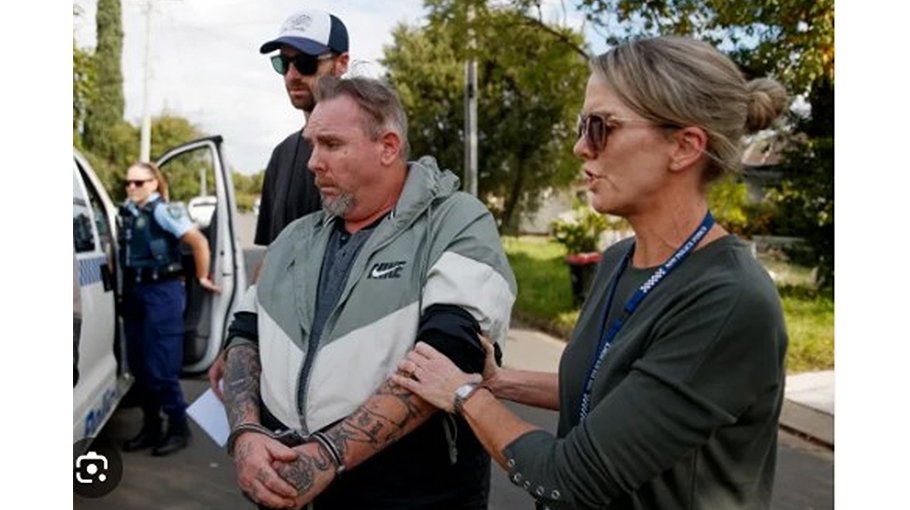
Police in Australia's most populous state announced Monday they had arrested and charged 554 domestic violence suspects in a four-day operation, as the country reckons with a series of high-profile attacks on women.
New South Wales police said some of "the worst domestic violence offenders" in the state had been rounded up, including one man who allegedly stamped on a woman, causing fractured ribs, facial injuries and a bruised kidney.
The arrests come as Australia grapples with the violent deaths of 28 women this year -- an average of one death every four days. Only 14 women died in violent incidents during the same period last year.
A series of high-profile attacks on women -- including the stabbing of five women at a Bondi mall -- have thrown the focus on gender-based and domestic violence.
Australian Prime Minister Anthony Albanese has called it a "national crisis", while announcing measures to curb deepfake pornography and increase funding for women fleeing abusive relationships.
Intimate partner homicides have gradually declined in the past 30 years, data from the Australian government shows.
And Australia's domestic violence prevalence rate still remains below the OECD average -- lower than that of Canada, the United States and Britain, according to 2023 data.
But domestic violence services have long warned more needs to be done.
Curtin University expert Donna Chung said the system is designed so that victims can often only get help once something bad happens.
Even then the system is flawed, and domestic violence perpetrators can continue to offend, she said.
- 'Scared to take a step' -
Michelle, one of the roughly 70 women a day who use Lou's Place, Sydney's only daytime domestic violence shelter, fled Melbourne after being abused by her ex-husband and his family.
She said she was not allowed to leave the house and was forced to withdraw from her schooling.
"They used me and they terrified me," she told AFP.
AP, Jerusalem
The helicopter crash in which Iranian President Ebrahim Raisi, the country’s foreign minister and other officials were killed is likely to reverberate across the Middle East, where Iran’s influence runs wide and deep.
That's because Iran has spent decades supporting armed groups and militants in Lebanon, Syria, Iraq, Yemen and the Palestinian territories, allowing it to project power and potentially deter attacks from the United States or Israel, the sworn enemies of its 1979 Islamic Revolution.
Tensions have never been higher than they were last month, when Iran under Raisi and Supreme Leader Ayatollah Ali Khamenei launched hundreds of drones and ballistic missiles at Israel in response to an airstrike on an Iranian Consulate in Syria that killed two Iranian generals and five officers.
Israel, with the help of the United States, Britain, Jordan and others, intercepted nearly all the projectiles. In response, Israel apparently launched its own strike against an air defense radar system in the Iranian city of Isfahan, causing no casualties but sending an unmistakable message.
The sides have waged a shadow war of covert operations and cyberattacks for years, but the exchange of fire in April was their first direct military confrontation.
The ongoing war between Israel and Hamas has drawn in other Iranian allies, with each attack and counterattack threatening to set off a wider war.
It's a combustible mix that could be ignited by unexpected events, such as Sunday's deadly crash.
A BITTER RIVALRY WITH ISRAEL
Israel has long viewed Iran as its greatest threat because of Tehran's controversial nuclear program, its ballistic missiles and its support for armed groups sworn to Israel's destruction.
Iran views itself as the chief patron of Palestinian resistance to Israeli rule, and top officials for years have called for Israel to be wiped off the map.
Raisi, who was a hard-liner viewed as a protégé and possible successor of Khamenei, chastised Israel last month, saying “the Zionist Israeli regime has been committing oppression against the people of Palestine for 75 years.”
“First of all we have to expel the usurpers, secondly we should make them pay the cost for all the damages they have created, and thirdly, we have to bring to justice the oppressor and usurper," he said.
Israel is believed to have carried out numerous attacks over the years targeting senior Iranian military officials and nuclear scientists.
There is no evidence Israel was involved in Sunday's helicopter crash, and Israeli officials have not commented on the incident.
Arab countries on the Persian Gulf have also long viewed Iran with suspicion, a key factor in the decision of the United Arab Emirates and Bahrain to normalize relations with Israel in 2020, and of Saudi Arabia to consider such a move.
A PROXY WAR STRETCHING FROM LEBANON TO YEMEN
Iran has provided financial and other support over the years to the Palestinian militant group Hamas, which led the Oct. 7 attack into Israel that triggered the Gaza war, and the smaller but more radical Palestinian Islamic Jihad, which took part in it. But there is no evidence that Iran was directly involved in the attack.
Since the start of the war, Iran's leaders have expressed solidarity with the Palestinians. Their allies in the region have gone much further.
Lebanon's Hezbollah militant group, Iran's most militarily advanced proxy, has waged a low-intensity conflict with Israel since the start of the Gaza war. The two sides have traded strikes on a near-daily basis along the Israel-Lebanon border, forcing tens of thousands of people on both sides to flee.
So far, however, the conflict has not boiled over into a full-blown war that would be disastrous for both countries.
Iran-backed militias in Syria and Iraq launched repeated attacks on U.S. bases in the opening months of the war but pulled back after U.S. retaliatory strikes for a drone attack that killed three American soldiers in January.
Yemen's Houthi rebels, another ally of Iran, have repeatedly targeted international shipping in what they portray as a blockade of Israel. Those strikes, which often target ships with no apparent links to Israel, have also drawn U.S.-led retaliation.
BEYOND THE MIDDLE EAST
Iran's influence extends beyond the Middle East and its rivalry with Israel.
Israel and Western countries have long suspected Iran of pursuing nuclear weapons in the guise of a peaceful atomic program in what they see as a threat to non-proliferation everywhere.
Then-President Donald Trump's withdrawal from a landmark nuclear pact between Iran and world powers in 2018, and his imposition of crushing sanctions, led Iran to gradually abandon all the limits placed on its program by the deal.
These days, Iran is enriching uranium to up to 60% purity — near weapons-grade levels of 90%. Surveillance cameras installed by the U.N. nuclear agency have been disrupted, and Iran has barred some of the agency's most experienced inspectors. Iran has always insisted its nuclear program is for purely peaceful purposes, but the United States and others believe it had an active nuclear weapons program until 2003.
Israel is widely believed to be the only nuclear-armed power in the Middle East but has never acknowledged having such weapons.
Iran has also emerged as a key ally of Russia following its invasion of Ukraine, and is widely accused of supplying exploding drones that have wreaked havoc on Ukraine's cities. Raisi himself denied the allegations last fall in an interview with The Associated Press, saying Iran had not supplied such weapons since the outbreak of hostilities in February 2022.
Iranian officials have made contradictory comments about the drones, while U.S. and European officials say the sheer number being used in the war in Ukraine shows that the flow of such weapons has intensified since the war began.
Michelle, who asked to be identified by a pseudonym, described a difficult path to safety -- first making the decision to leave, and then facing hurdles finding somewhere safe to go.
"I have seen many women, and even I was one of them, they're very scared to take a step (and escape)," she said. "It's hard to find the place you feel safe."
After failing to gain access to other domestic violence services, she found Lou's Place and is now training to be a hairdresser.
Her experience is far from unique -- in Australia, it is estimated one in four women will experience some form of domestic violence in their lives.
- Worsening 'crisis' -
Lou's Place general manager Amanda Greaney said Australia's domestic violence problem had reached the "crisis" level.
She said the rising cost of living and shortages in housing -- coupled with a lack of crisis centres -- forced women to remain in abusive situations, adding that could be among the reasons for the recent uptick in deaths.
Lou's Place has a policy of not turning anyone away, Greaney said, but that was becoming increasingly difficult as more women seek support.
"It's going to cost a lot of money, but women and children are living in fear and that's just not good enough. We need to stop it," she said.
Advocacy group No to Violence believes better education is needed about healthy relationships, as well as more research into what drives men's violent behaviour, according to chief executive Phillip Ripper.
"The forces that lead to family violence are very complex and very interrelated. There is no simple solution," he said.