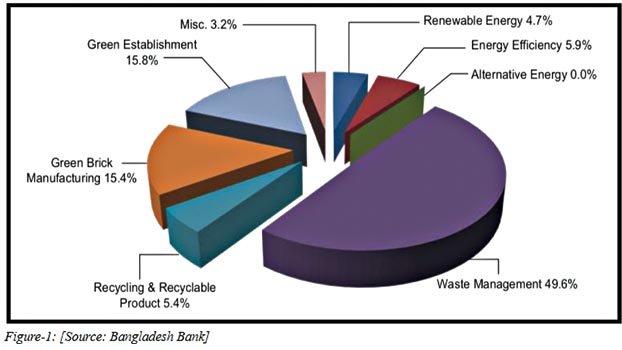
“Sustainable banking is getting momentum in developing countries and Bangladesh has been one step ahead now by initiating particular sustainable banking activities in various fields. The country has many success stories surrounding corporate governance, corporate social responsibility, social awareness of stakeholders, preparing sustainability reporting under globally accepted method-GRI (Global Reporting Initiative) and leadership with green banking being one of the most notable initiatives. In 2011, Bangladesh Bank (‘BB’), the regulatory authority of commercial banks in Bangladesh, issued “Policy Guidelines for Green Banking” to implement and promote green banking activities across the country in three phases”- published an article by Asian Banking & Finance (ABF), Singapore on January 08, 2020. ABF is a leading and influential journal for banking and finance executives in Asia.
It is said in the article, “Sustainable banking is a key driver to confirm the world’s overall wellbeing in accordance with the United Nations Sustainable Development Goals (SDGs) which are to be achieved by 2030. As an integral part of sustainable banking, sustainable development is directly associated with the economic, environmental, and social aspects. Sustainable banking aims for greater development through more promising financing opportunities which need to be sustainable in all of these three aspects. While financial return and risk are the only focus of traditional banking activities, sustainable banking has its focus on the environmental, economic, and social returns emphasizing the transition from the existing narrow shareholder model to the framework of a large volume of stakeholders and aiming at adding long-term value to the broader community.”
The title of write up is, “What you must know about sustainable banking activities in Bangladesh” authored by Md. Touhidul Alam Khan, Deputy Managing Director of Prime Bank Ltd.
”In Bangladesh, the concept of sustainable banking is keeping on agricultural financing, financial inclusion drives, corporate social responsibility, green banking, micro and small enterprise financing along with many steps for financial inclusion activities. All of these activities and programs are clearly linked with the UN’s SDGs which Bangladesh is working to achieve by 2030. BB’s strategic interventions and policies indicate its intention to support the government initiatives by upholding the agenda of sustainable banking throughout the country”, opined by Khan in his article who is also the first Certified Sustainability Reporting Assurer (CSRA) in Bangladesh and fellow of Cost & Management Accountants of ICMAB.
“BB has a plan to provide midsize manufacturing firms, exporters, small and medium-sized enterprises (SMEs), and other private sector companies with an estimated in long-term finances partnering with the International Development Association (IDA) under the Financial Sector Support Project (FSSP) with the goal to facilitate economic development and ensure development outcomes that are environmentally and socially sustainable.”
Touhidul Alam Khan writes, “As part of BB’s drive for financial inclusion, school banking facilities have been introduced in November 2010. In 2013, BB introduced ‘Guidelines for School Banking’ which allows any student aged up to 18 years to open a school banking account under the supervision of a legal guardian or parents by depositing only BDT 100.00.”
The report says, “In 2014, BB has given a guideline to encourage the ‘10 Taka Special Account’ for street urchin and working children with a view to safeguarding their hard-earned cash, securing their future, and making them financially independent. BB has also taken initiatives to promote a financial inclusion tool that offers the poor and underprivileged section of the population mostly from remote locations, some tailor-made financial services and products which are available in their vicinity and designed to meet their typical financial needs at a reasonable cost. In 2013, Bangladesh Bank created ‘Agent Banking’ guidelines to accelerate a safe, hassle-free, and secured alternative channel to deliver financial services to the unbanked population which marks a significant initiative to promote sustainable banking in Bangladesh.”
Md. Touhidul Alam Khan is also expert and working on Sustainable Development Goals (SDGs) and he presented papers on this topic on Bangladesh perspective in Indonesia & Thailand recently. He also worked as member of Jury Board and Member of Scientific Committee of International Sustainable Development Conference held in July, 2019 in Thailand.
Md. Touhidul Alam Khan, FCMA, CSRA
Deputy Managing Director
Prime Bank Ltd.