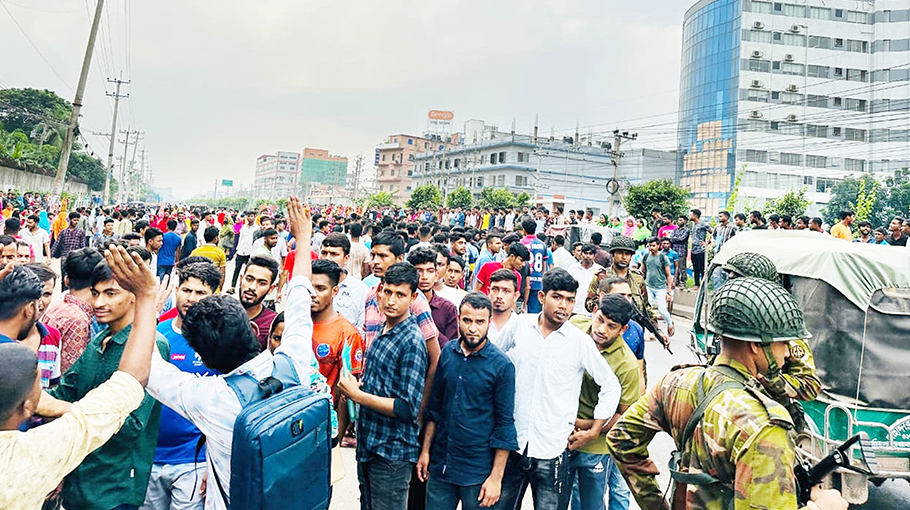
At least 30 garment factories were shut down at Ashulia, on the outskirts of the capital city, on Monday as workers staged demonstrations to press home their various demands, including job regularisation and salary hike.
The agitating workers along with job seekers staged demonstrations blocking multiple key points along Dhaka-Mymensingh highway from Gazipur Sadar to Tongi, leading to severe traffic congestion during rush hours.
Witnesses said that workers and job seekers blocked Nabinagar-Chandra Road and Baipail-Abdullahpur Road since Monday morning. Unrest erupted around 9:00 am when garment workers of Gildan Bangladesh started holding protests on Nabinagar-Chandra Road in Palashbari area of Savar.
However, job seekers also staged demonstrations in front of Dhaka Export Processing Zone (DEPZ).
In Narsinghpur area, workers from several garment factories staged protests on Abdullahpur-Baipail Road and continued their blockade programme until 2:00 pm. The demonstrations caused severe traffic jam, particularly on Nabinagar-Chandra highway, leaving many passengers, including schoolchildren, patients, and elderly people, stranded.
Industrial police and army personnel eventually intervened, assuring the protesters and clearing Baipail-Abdullahpur Road, restoring normal traffic flow by 2:30 pm. But job seekers continued to block Nabinagar-Chandra Road near DEPZ, demanding gender-equitable recruitment.
A Gildan Bangladesh worker, seeking anonymity, said that their demands include job security for a minimum of 10 years, an increase in attendance bonuses from Tk 300 to Tk 800, and promotion based on a minimum of three years of service and qualification. By 10:30 am, the Gildan Bangladesh authority announced an indefinite closure of its factory, citing “unforeseen and unexpected events.”
Pearl Garments Company Limited also declared a paid holiday for its employees.
Mohammad Sarwar Alam, Superintendent of Police (SP) of Ashulia Industrial Police-1, said that the workers from various garment factories were protesting layoffs and demanding attendance bonuses. In response, the authorities concerned declared holidays at 30 factories.
In Gazipur, workers continued to block highways, demanding job regularisation, payment of arrears, and equitable hiring. Protests erupted in different areas such as Chandana Chowrasta, Bhogra, Naozor, Konabari, Board Bazar, and Tongi since Monday morning, resulting in nagging traffic congestion on Dhaka-Mymensingh highway and nearby roads.
On Sunday, workers from 20 pharmaceutical companies, a shoe factory, a ceramic factory, and several garment factories in Savar and Gazipur staged similar protests, leading to road blockades in those areas. Although the management assured workers that their demands would be met in phases, protests continued, disrupting the supply chain.
Workers from at least 10 factories, including garment and pharmaceutical plants, also held demonstrations across Tongi, Kaliakoir, and Sadar upazilas of Gazipur district on Monday. The protesters blocked Dhaka-Mymensingh highway on Monday morning, causing severe traffic gridlocks.
Reports indicate that male job seekers briefly blocked the highway in front of Interstoff Apparels Ltd, alleging that the factory had refused to hire them despite earlier assurance. The situation escalated when some job seekers threw bricks at the factory, leading to a clash with current workers.
The situation was brought under control after the arrival of Army and Border Guard Bangladesh personnel.
Additionally, workers from UniMed UniHealth Pharmaceuticals Ltd went on strike to press home their 21-point demand, including job security and wage hikes. They occupied the area in front of the factory’s main entrance in Bikebari, Gazipur.
Meanwhile, Bata Shoe Company workers also went on strike, demanding higher wages.
The workers of Bata Shoe company have been demonstrating since Sunday to press home their eight-point demand, including an increase in salary, monthly salaries instead of weekly payment, and stopping termination of workers.
Imran Ahmed, Additional Superintendent of Industrial Police-2 in Gazipur, confirmed that workers from 11 factories staged protests in various places, including Bhogra, demanding jobs, an end to discrimination against women, and increasing salaries and allowances. Law enforcement agencies were actively working to bring the situation under control.
On August 27, a meeting between BGMEA leaders, Bangladesh Army officials, and law enforcement agencies expressed concern over recent labour unrest and subsequent road blockades. The meeting emphasized the need for timely payment of wages and regular communication between the factory management and workers to foster harmonious industrial relations.
Despite these efforts, the situation remains tense as the authorities, factory owners, and workers' representatives have yet to take effective measures to prevent ongoing unrest.
In response to escalating protests, law enforcement and army personnel have been deployed in Dhaka and surrounding areas, including Ashulia, Savar, Mirpur, Rampura, Abdullahpur, Tongi, Gazipur, and Konabari, to ensure security.
Workers protests have become a common phenomenon in the country, often sparked by issues such as unpaid wages, bonuses, and arrears. Current unrest in the RMG sector has led to increasing violence on highways and within the city over the past two weeks.