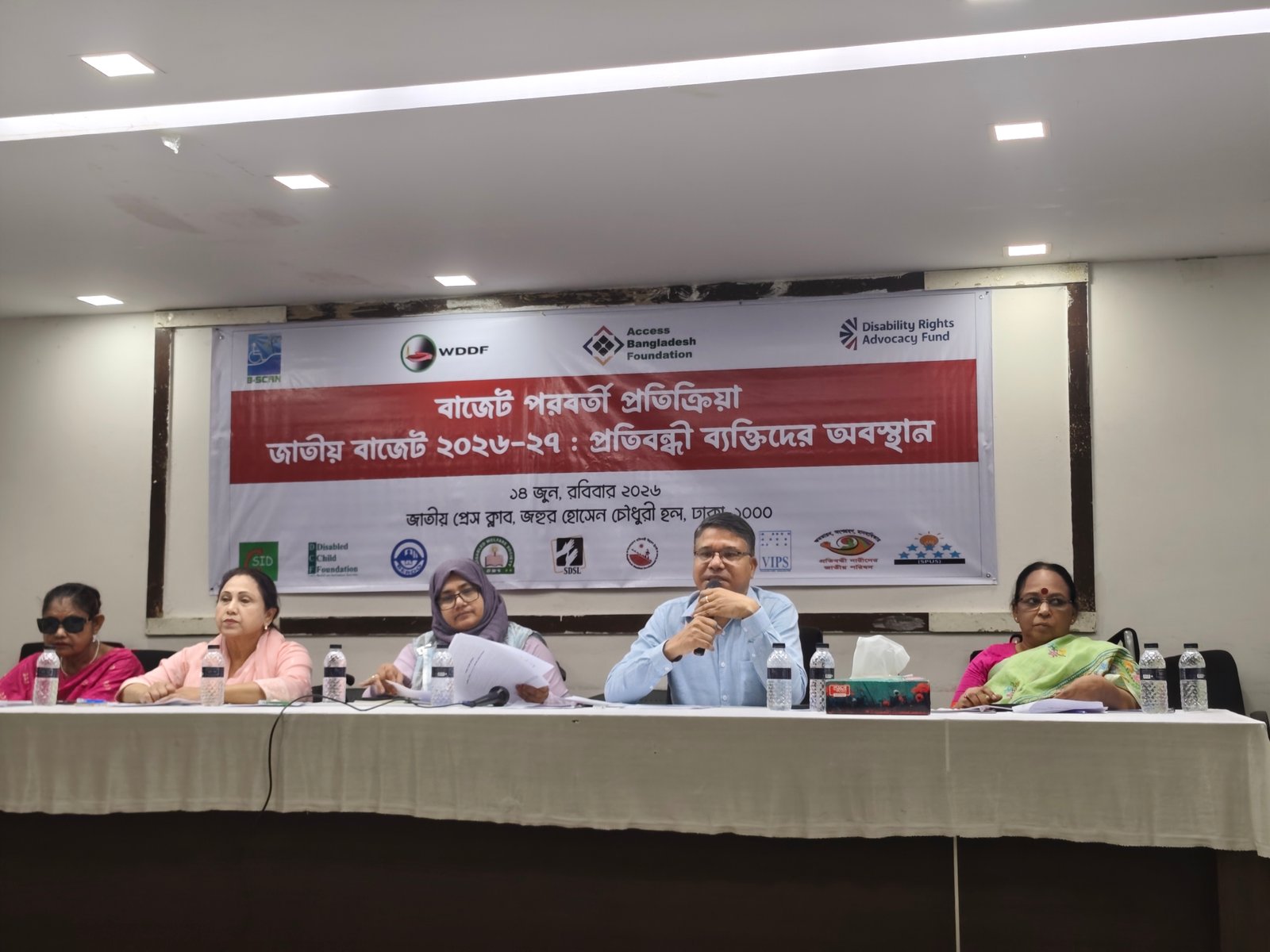
A coalition of 14 organizations working for the rights of persons with disabilities, led by the Access Bangladesh Foundation, has expressed a joint reaction to the proposed BDT 9,38,000 crore national budget for the fiscal year 2026-27 declared by the Government of the People's Republic of Bangladesh. While acknowledging some positive adjustments, the organizations jointly stated that the total budget allocation remains highly inadequate to meet the actual needs of persons with disabilities in Bangladesh.
In a joint reaction meeting held Sunday, June 14, 2026, the coalition pointed out that although allowances and educational stipends for persons with disabilities have been marginally raised in the new budget, the increase is entirely insufficient against the current backdrop of skyrocketing commodity prices and high market inflation.
The keynote statements during the meeting were delivered by Albert Mollah, Executive Director of Access Bangladesh Foundation, and Ashrafun Nahar Misti, Executive Director of the Women with Disabilities Development Foundation. The joint statement was given by 14 prominent organizations: Access Bangladesh Foundation, Women with Disabilities Development Foundation, B-SCAN, Disabled Child Foundation, Disabled Welfare Society, Society of the Deaf and Sign Language Users, Blind Education and Rehabilitation Development Organization, Bangladesh Pratibandhi Unnayan Trust, Satarkul Pratibandhi Unnayan Sangstha, National Council of Disabled Women, Center for Services and Information on Disability, Visually Impaired People’s Society, Disabled Different Program, and the Disability Rights Advocacy Fund.
The speakers extended their sincere appreciation to the Honorable Prime Minister and the Finance Minister for several crucial progressive steps taken in the FY 2026-27 budget, which include:
• Increasing the monthly disability allowance from BDT 900 to BDT 1,000.
• Expanding the number of allowance beneficiaries from 34.5 lakh to 38 lakh.
• Increasing both the monetary size and beneficiary coverage of the student with disabilities education stipend.
• Reducing the advance income tax (AIT) from 2% to 1% on the import of 15 essential assistive devices.
However, the coalition expressed profound concern and deep anxiety over the macro-allocations. The total budget for the disability sector stands at BDT 4,972.56 crore, which constitutes a mere 3.45% of the overall social security sector budget, and an alarming 0.53% of the entire national budget.
To address these disparities, the 14 organizations have placed some major demands for a comprehensive budget revision:
1. Budget Allocation in Line with the Election Manifesto: Reflect the commitments made in the election manifesto through dedicated budget allocations, including the introduction of a National Civic Service to promote employment opportunities for persons with disabilities, the establishment of a special fund for their development, and the provision of medical treatment, sustainable employment, and rehabilitation support for individuals who acquired disabilities during the July Movement.
2. Substantial Increase in Monthly Allowances: Fix the minimum monthly allowance at BDT 5,000 for persons with severe disabilities and BDT 2,000 for persons with moderate disabilities to shield them from ongoing inflationary pressures.
3. Introduction of a Caregiver Allowance: Launch a dedicated monthly caregiver allowance of BDT 3,000 for full-time caregivers of individuals with profound or highly severe disabilities.
4. 100% Educational Stipend Coverage & Disability Allowance: Bring all students with disabilities nationwide under the education stipend net, ensuring they concurrently receive both their educational stipend and the monthly disability allowance without any exclusionary barriers.
5. Ministry-Wise Specific Budgetary Allocations: Beyond the Ministry of Social Welfare, explicit and targeted budgetary allocations must be introduced for the development of persons with disabilities across other line ministries, including the Ministry of Primary and Mass Education, Ministry of Education, Ministry of Health and Family Welfare, Ministry of Youth and Sports, Ministry of Labour and Employment, and the Ministry of Women and Children Affairs.
6. Dedicated Allocation for Skill Training and Employment: Provide specific budget allocations aimed directly at implementing skill development training programs and generating viable employment opportunities for persons with disabilities.
7. Artificial Limbs and Assistive Devices: Allocate budget for government initiatives to produce artificial limbs and a wide range of assistive devices tailored to the diverse needs of persons with disabilities.
8. Prioritization in Social Protection Schemes: Ensure strict operational prioritization for farmers and women with disabilities during the distribution of state cards, such as Digital Health Cards, Farmer Cards (Krishak Cards), and Family Cards.
9. Financial Support for Grassroots OPDs: Allocate specific state budgetary funds to support Organizations of Persons with Disabilities (OPD) functioning at local and national levels to ensure the effective implementation of development programs.
10. Allocation for Laws and Policies Implementation: Ensure dedicated budget allocations for the effective implementation of national disability-related laws, policies, and action plans.
The coalition strongly criticized the budget formulation process, highlighting that no pre-budget consultations or discussions were held with persons with disabilities or their organizational representatives. They strongly urged the government to shift its paradigm from a mere "charity or welfare-based" perspective to an inclusive, "rights-based" approach. The 14 organizations issued a fervent call to the government to reconsider and revise the proposed budget during the ongoing parliament session.