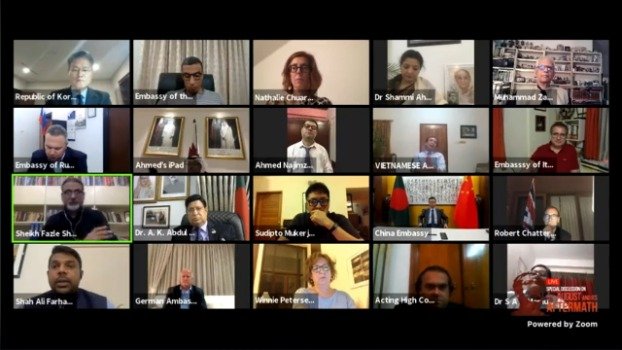
While interacting with ambassadors, high commissioners and representatives of over 40 countries including India, China, UK and Germany at a discussion on Saturday, foreign minister Dr. A. K. Abdul Momen highlighted the impact of Bangabandhu Sheikh Mujibur Rahman to the independence of the country.
He brought up Bangabandhu’s sacrifices, incarceration, his dream, and vision of an independent nation and the undying love for the Bangali people.
Dr Momen was addressing the discussion “15th August And Its Aftermath” moderated by Special Assistant to Prime Minister Barrister Shah Ali Farhad.
The ruling Awami League organised the discussion. Bangladesh Awami Jubo League chairman Sheikh Fazle Shams Parash was the keynote speaker at the discussion.
AL International Affairs Sub Committee chairman Muhammad Zamir, AL International Affairs Secretary Dr. Shammi Ahmed and diplomats from various Missions stationed in Dhaka were present.
Ambassadors, High Commissioners and representatives of over 40 countries including India, China, UK and Germany took part in the discussion hosted by AL International Affairs Sub Committee.
A booklet titled: “The Darkest Night and Its Aftermath” was virtually unveiled during the discussion and hard copies will also be shared with all Foreign Missions in Dhaka.
Dr Momen highlighted the turnaround that the country experienced since 1971, where he led the country to economic development before his untimely demise.
He stated the foundations of Bangladesh’s foreign policy is built around the notion developed by Bangabandhu of “friendship to all, and malice to none.”
He called on the diplomatic friends to work with the nation to achieve the Bangabandhu’s dream of “Sonar Bangla.”
Robert Chatterton Dickson, British High Commissioner in Dhaka, stated that the United Kingdom was the first nation Bangabandhu visited following his release from captivity where he was greeted by then British Prime Minister, Edward Heath.
He stated that this laid the foundation for the successful relationship between the two nations.
Li Jiming, Ambassador of China, remembered that even in this solemn occasion, he brought forward the visits of Bangandhu to China in 1952 and 1957 and reminisced the warm welcome Bangabandhu received from the Chinese people.
He asserted that the visionary leadership of Bangabandhu set the values of current Bangladesh and stated Bangabandhu’s legacy is being carried forward by his daughter, Sheikh Hasina, Hon’ble Prime Minister of the People’s Republic of Bangladesh.
Peter Fahrenholtz, the German Ambassador, stated about the visionary leadership of Bangabandhu and the moral values of the Father of the Nation.
He asserted that all relevant stakeholders should work together to bring it to reality his ideology of secular Bangladesh while social rights for all.
D.P.S.N. Dayasekara, the High Commissioner of Sri Lanka to Bangladesh, stated that Sri Lanka was one of the first countries to establish a relationship with Bangladesh following our liberation.
He claimed that everyone should follow the values set by Bangabandhu to ensure equal rights for all.
Mia Seppo, Resident Coordinator in Bangladesh, United Nations asserted that the values of Bangabandhu of freedom for all, ideals of leaving no one behind and equality amongst all match the foundations of sustainable development, which are critical values of the U.N. as well.
She stated that the U.N. has been a staunch ally in playing a role in the development of Bangladesh and wishes to continue doing so.
Nathalie Chuard, the Swiss Ambassador, said she was deeply moved after hearing the narration of the brutality of Aug 15. She shared that Switzerland has been a robust ally to Bangladesh and was delighted to hear that it was Bangabandhu’s vision that Bangladesh be the “Switzerland of the East.”
She wished that this relationship between the two nations be as strong as it has been over the years.