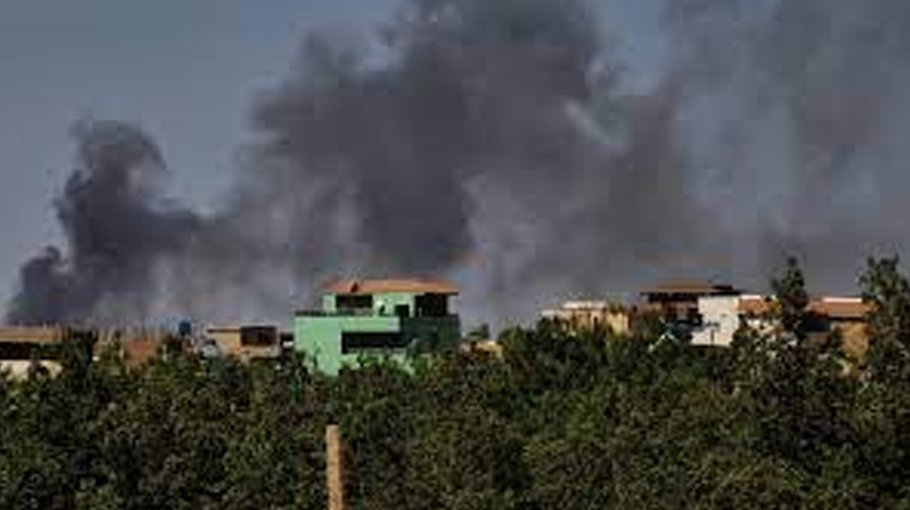
Air strikes battered Sudan's capital on Saturday, as fighting entered a fourth week only hours before the warring parties are to meet in Saudi Arabia for their first direct talks.
Hundreds of people have been killed since the outbreak of the conflict on April 15 between Sudan's de facto leader Abdel Fattah al-Burhan, who leads the regular army, and his deputy turned rival Mohamed Hamdan Daglo, who commands the paramilitary Rapid Support Forces.
The fighting has seen warplanes bomb targets in Khartoum and the two rival generals' forces engage in intense street battles in the city of five million inhabitants. Multiple truces have been reached, but none has been respected.
In a joint statement, the United States and Saudi Arabia said the army and
RSF would hold direct discussions in Jeddah on Saturday, describing them as "pre-negotiation talks".
"Saudi Arabia and the United States urge both parties to take in consideration the interests of the Sudanese nation and its people and actively engage in the talks toward a ceasefire and end to the conflict," they said.
The army confirmed it had sent envoys to Saudi Arabia to discuss "details of the truce in the process of being extended" with its paramilitary foes.
Daglo, commonly known as Hemeti, took to Twitter to welcome the talks and thank the US, Saudi Arabia and other international players for their efforts.
The general, whose RSF descended from the Janjaweed militia accused of war crimes Sudan's Darfur region, affirmed "the need to reach a civilian transitional government that... achieves the aspirations of our people".
Both the army and the RSF have sought to present themselves as protectors of
democratic values, despite staging a coup in 2021 that derailed the country's
transition to civilian rule.
- International mediation -
On Saturday morning, witnesses said warplanes pounded various parts of the
capital Khartoum, where telecommunications company MTN said all of its
services had been interrupted.
Burhan had given his backing to a seven-day ceasefire announced by South
Sudan on Wednesday, but early on Friday the RSF said it was extending by
three days a previous truce brokered under US-Saudi mediation.
The US-Saudi statement noted the efforts of other countries and organisations
behind this weekend's talks, including Britain, the United Arab Emirates, the
Arab League, the African Union and other groups.
Khalid Omer Yousif, a former minister, expressed hopes the talks would lead
to "a complete ceasefire that paves the way for a comprehensive political
solution".
At least 700 people have been killed and thousands injured in the fighting
that has displaced hundreds of thousands either internally or across the
border to neighbouring countries.
Neighbouring South Sudan, which had negotiated the seven-day truce extension,
said late Friday that its president, Salva Kiir, had spoken to the Sudanese
generals about "his concerns and those of the IGAD leaders" from the East
African regional grouping.
While the army had previously said it favoured "African solutions to the
continent's issues", it was ultimately the US-Saudi initiative that gained
leverage as Sudan had been suspended from the African Union since the 2021
coup.
Burhan and Daglo had together orchestrated the coup in October that year,
derailing the democratic transition that had been painstakingly stitched
together following the ouster of former autocrat Omar al-Bashir in 2019.
But they later fell out in a bitter power struggle, most recently over the
integration of the RSF into the army.
- Humanitarian crisis -
The announcement of the direct talks came following warnings from US
intelligence chief Avril Haines of a "protracted" conflict that would "create
a greater potential for spillover challenges in the region".
The fighting persisted despite warnings from US President Joe Biden on
Thursday of possible sanctions against those responsible for "threatening the
peace, security, and stability of Sudan" and "undermining Sudan's democratic
transition".
Sudan suffered decades of sanctions during the rule of Bashir, ousted in a
palace coup in 2019 following mass street protests.
The UN refugee agency, UNHCR, has said it is preparing for an outflow of
860,000 people as a result of the conflict.
The UN has also warned the fighting could plunge an additional 2.5 million
people into food insecurity within months, meaning 19 million people would
need aid to stave off famine.
Its children's agency, UNICEF, said "the situation in Sudan has become fatal
for a frighteningly large number of children".