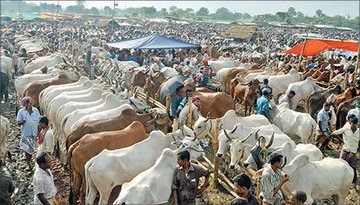
The government’s announcement that there is no need to import sacrificial animals for the upcoming Eid-ul-Azha is undoubtedly reassuring. According to Fisheries and Livestock Minister Mohammad Aminur Rashid, more than 12.4 million cattle, buffaloes, goats, and sheep have already been prepared across the country for sacrifice this year. This indicates that Bangladesh has achieved a significant level of self-sufficiency in livestock production, reducing dependence on imports from neighboring countries.
The decision to stop cattle imports and suspend leases for border cattle markets reflects the government’s confidence in local farmers and livestock producers. It is also a positive step for protecting domestic farmers, who invest heavily throughout the year in raising sacrificial animals. Preventing unnecessary imports can help ensure fair returns for them and strengthen the rural economy.
The government’s plan to establish more than 3,600 cattle markets nationwide, including 27 in Dhaka, also shows administrative preparedness. The assurance that markets will be set up only at designated places and will not disrupt traffic movement is important for urban management. Likewise, the deployment of veterinary teams in every market and the continuation of restrictions on harmful injections for artificial fattening are commendable measures for public health and consumer protection.
However, while the supply side appears strong, the real challenge lies in market management. Bangladesh’s experience with Eid cattle markets has often been disappointing. Every year, complaints emerge about chaos, illegal toll collection, middlemen’s dominance, and artificial shortages—especially in Dhaka and other major cities. These problems often push prices beyond the reach of ordinary buyers.
Middlemen and influential groups frequently manipulate the flow of animals entering city markets. Through various informal controls, they create scarcity and drive up prices. Consumers then suffer from inflated costs, while genuine farmers often do not receive fair profits. Instead, the benefits are captured by syndicates operating behind the scenes.
This year, the risk may be even greater if local political leaders and activists become involved in controlling temporary cattle markets. Market leases, transportation routes, and entry points can become centers of influence and unfair advantage. If such political interference is not checked, the government’s good intentions may fail to deliver results for the public.
Therefore, the Ministry of Home Affairs, law enforcement agencies, city corporations, and local administrations must act in close coordination. Strong monitoring is needed to prevent extortion during animal transportation by road and waterways. Illegal toll collection must be stopped without exception. Market committees should be transparent and free from partisan control.
Consumers should also be protected from excessive fees and hidden charges. While no tax on online cattle trading is a welcome step, physical market fees must remain reasonable and properly regulated. Authorities should ensure that buyers are not exploited under the excuse of market management costs.
Most importantly, temporary cattle markets must not become centers of disorder and political patronage. They should serve farmers and consumers—not syndicates. Fair pricing, safe trading conditions, and smooth transportation are essential for a peaceful Eid celebration.
Bangladesh has enough sacrificial animals this year. That should be a source of confidence, not concern. But adequate supply alone is not enough. Without strict supervision and honest enforcement, market disorder can still turn abundance into hardship. The government must ensure that this Eid-ul-Azha is remembered for fairness, not frustration.