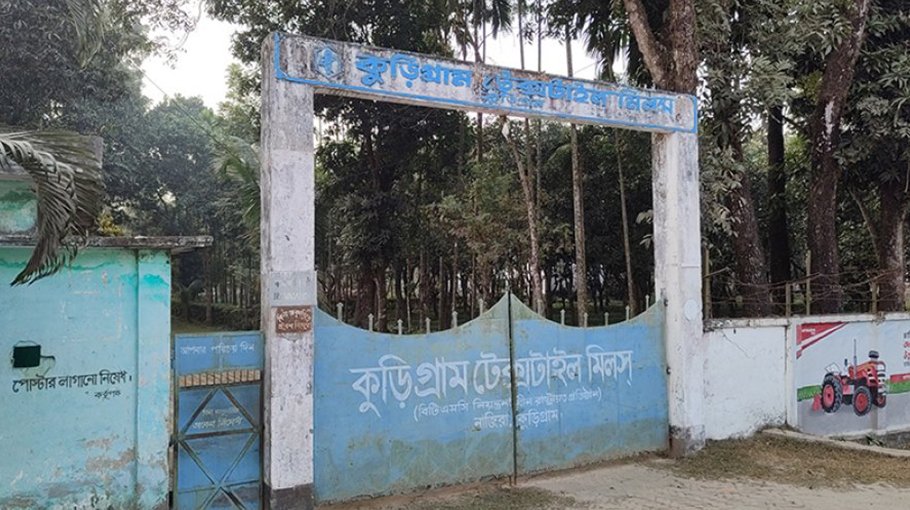
The temporary campus of Kurigram Agricultural University is to be located in the closed Kurigram Textile Mills premises with the aim of establishing the world's most advanced technology-based agricultural university. On Saturday afternoon, the Vice-Chancellor (VC) Professor Dr AKM Zakir Hossain of Kurigram Agricultural University confirmed that students will be admitted in two subjects in the next academic year if permission is granted.
He also said that this mill has been closed for more than a decade. In view of the application of the Vice-Chancellor of the University, approval has been received from the relevant departments including the Textile and Jute Ministry. If everything goes well, the textile mills premises are going to be the temporary campus of the university.
Dr. AKM Zakir Hossain said, 'We have asked for a campus in the closed Kurigram Textile Mills premises to start the education program of Kurigram Agricultural University. After our proposal was approved in the board meeting of BTMC, it has been sent to the ministry. I have learned that the Ministry has approved it. Now if the UGC gives permission, we will use the textile mills premises as a temporary campus of the university.
The Vice-Chancellor said, 'We will rent the Textile Mills premises as a university campus on a temporary basis. Now if the UGC approves the rent, we will start the process.
Kurigram Textile Mills was established by the Government of Bangladesh in 1987. The state-owned enterprise belonging to Bangladesh Textile Mills Corporation (BTMC) is located along the Kurigram-Chilmari highway in Nazira area south of the district town in Kuripram town area. Although operational for a time, production stopped in 2011 in the face of continuous losses. Since then this mill has been closed. A few members including a manager are currently working in the mill as officers of BTMC. But since several years the buildings inside it are being rented out as residential.
Covering an area of more than 15 acres, the campus of the mill is surrounded by a boundary wall and is filled with greenery. It has herringbone roads, fields, ponds with large trees. Apart from this, there is enough space for gardening.
Vice-Chancellor highlighted the suitability of the textile mills square for the temporary campus of the university. Zakir Hossain said, 'Textile Mills premises will be suitable for the campus. It is a good campus. There are several issues to manage the activities of Agricultural University including the safety of students. Agricultural university students need field for resource. The textile mills premises have fields, trees and ponds. As a result it will be good for research and other activities of the university. Now if the UGC approves and allocates the necessary reforms, we will officially start the process.
Admission of students in the next academic year: Initiatives are being taken to admit students from the next academic year (2022-2023), the Vice-Chancellor Zakir Hossain said, "We have submitted an application to the UGC for student admission. Accordingly, I have submitted the course curriculum, content. Now if the UGC approves, we can start the admission process.
"We are getting a good campus. A committee has been formed by Ministry of Education and UGC. They will talk to the Prime Minister and decide how the academic activities of the new universities will be conducted. If they give me a decision, I can start the process.
If permission is granted, students will be admitted to Kurigram Agricultural University in two subjects, said the University Vice-Chancellor. Each subject can have 30 seats. He said, "In the first year, we will admit students in fisheries and agriculture. The number of seats and subjects will be increased next year.
Earlier, on 15 September 2021, Parliament passed the 'Kurigram Agricultural University Bill-2021'. According to the bill, the university will take necessary measures for teaching and research and training at undergraduate and postgraduate level in various subjects of agricultural science. In addition to educational activities, the university will organize exhibitions on sustainable agricultural technologies and high-yielding agricultural products.