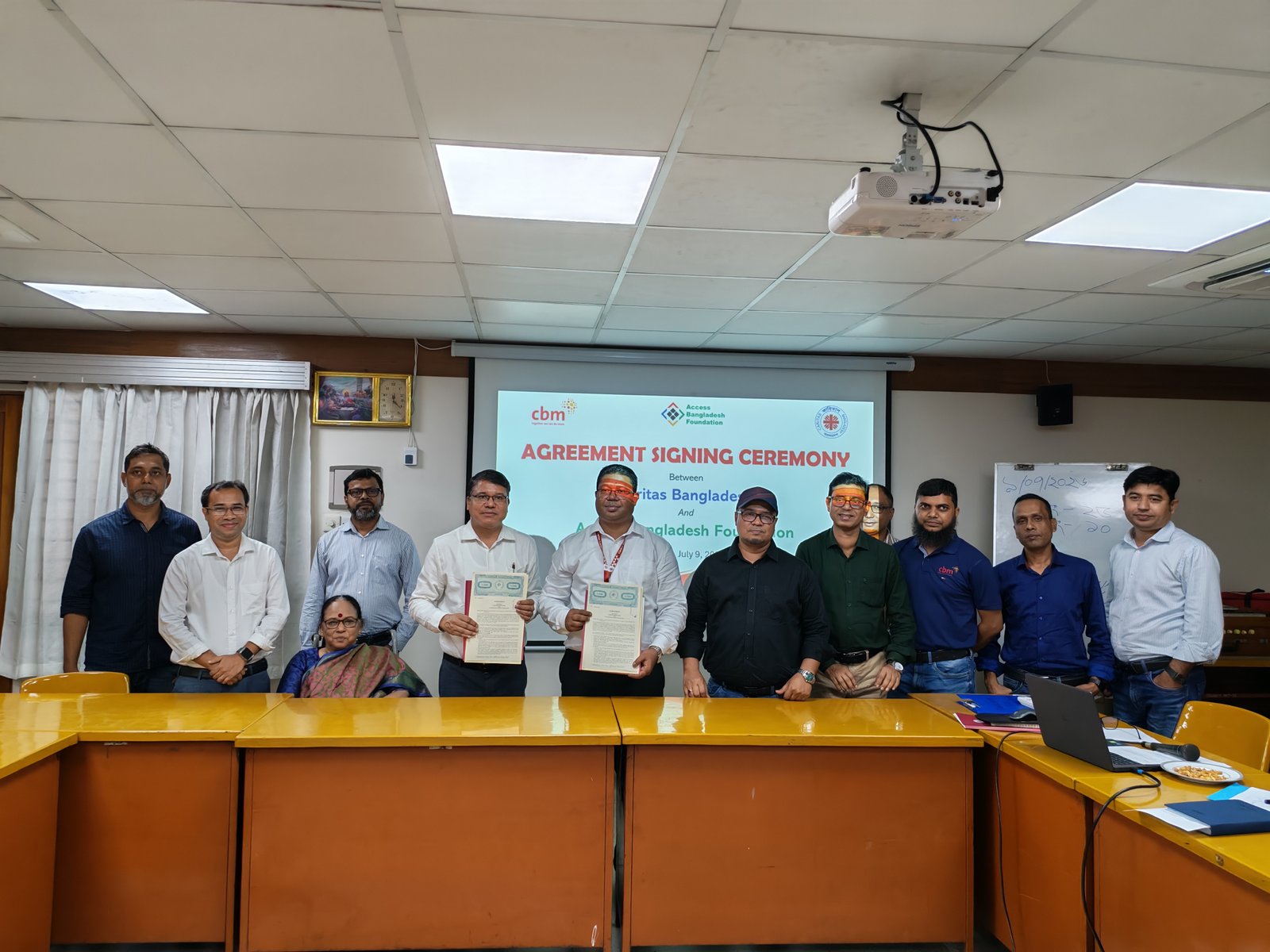
Access Bangladesh Foundation and Caritas Bangladesh on Thursday signed a Memorandum of Understanding (MoU) to implement the "Disability Inclusive Disaster Risk Management in Khulna District (DiDRM CALL Programme)," with support from CBM Global Bangladesh and CBM Switzerland.
The partnership marks a significant step towards strengthening disability inclusive disaster risk management through collaboration, local leadership, and the meaningful participation of persons with disabilities.
The project will be implemented in Sutarkhali Union of Dacope Upazila and Moharajpur Union of Koyra Upazila in Khulna District, aiming to build resilient and inclusive communities where no one is left behind in disaster risk management.
The agreement signing ceremony brought together senior representatives from Access Bangladesh Foundation, Caritas Bangladesh, and CBM Global Bangladesh, reaffirming their shared commitment to advancing inclusive disaster preparedness, response, and resilience.
The event commenced with welcome remarks by Daud Jibon Das, Executive Director of Caritas Bangladesh.
He welcomed the partnership and highlighted the importance of coordinated efforts among development partners, local stakeholders, and Organizations of Persons with Disabilities (OPDs) to strengthen disability inclusive disaster risk management.
Mohua Paul, Chairperson of Access Bangladesh Foundation, expressed her appreciation for the partnership and emphasized that close collaboration among all stakeholders will be essential to achieving the programme's objectives. She noted that the agreement reflects a shared commitment to promoting inclusion and ensuring that persons with disabilities actively contribute to disaster preparedness and resilience efforts.
Mohammed Zahidur Rahman, Country Director of CBM Global Bangladesh, congratulated both organizations on the partnership. He emphasized the importance of maintaining strong compliance, ensuring quality implementation, generating evidence for learning, and demonstrating measurable impact. He further highlighted that local leadership and meaningful partnerships with OPDs must remain at the centre of disaster risk reduction efforts.
Albert Mollah, Executive Director of Access Bangladesh Foundation, thanked Caritas Bangladesh, CBM Global Bangladesh, and CBM Switzerland for their trust and partnership. He reaffirmed Access Bangladesh's commitment to implementing the programme with transparency, accountability, and the meaningful participation of persons with disabilities. He emphasized that the initiative will adopt evidence-based approaches, strengthen local capacities, and contribute to sustainable and inclusive disaster resilience.
The Memorandum of Understanding was formally signed by Albert Mollah, Executive Director of Access Bangladesh Foundation, and Daud Jibon Das, Executive Director of Caritas Bangladesh.
The ceremony was moderated by Md. Tauhidul Islam, Program Officer, Disaster Management, Caritas Bangladesh.
Among others present at the ceremony were Md. Shohel Rana, Head of Program, and Shantanu Mondal, Finance Manager of Access Bangladesh Foundation.
Representatives from CBM Global Bangladesh included Md. Firoz Rahman, Programme Manager. Caritas Bangladesh was represented by Apurbo Mrong, Director, Programmes, Remi Subash Das, Director, Finance and Administration, Tomas Baroi, Head of Accounts, and Alexander Tripura, Head of Disaster Management Sector, along with other officials from the three organizations.
The DiDRM CALL Programme seeks to strengthen disability inclusive disaster risk management by fostering collaboration among local actors, promoting the leadership of persons with disabilities, and generating evidence to improve inclusive policies and practices. Through this partnership, Access Bangladesh Foundation and Caritas Bangladesh will work closely with communities and local self-help groups of persons with disabilities to enhance preparedness, strengthen resilience, and ensure that disaster risk reduction actions are inclusive, accessible, and sustainable.