Emon Mahmud, JU Correspondent
Winter is one of the most favourite seasons for most of the Bangladeshis as the weather during this time remains rather soothing. Bangladesh as a country with short-lived winter season offers an ideal hospitable environment to millions of migratory birds mainly from the Siberian region. The guest birds fly in from thousands of miles away, from trembling cold parts, northern hemisphere, and across the globe including Siberia, China, Nepal, Himalayans, Mongolia, Xinxian. The birds, in search of food and to escape the unbearable cold of the northern countries of the globe, migrate to modest temperature zones like Bangladesh.
The migratory birds flock to the evergreen Jahangirnagar University (JU) campus at the very outset of winter every year. Much to the relief of nature enthusiasts and environmentalists, migratory birds have started arriving while water lilies have begun blossoming on the lakes of Jahangirnagar University with the advent of winter this year. Likewise, there is a buzz that JU is a haven for the guest birds and a role model of peaceful coexistence of humans and animals.
Native and migratory birds that travel to JU every winter, to take refuge in several lakes and water bodies on the campus, are undoubtedly the most beautiful and significant feature of the country's only residential university. The mist-covered green landscape of the university has a large number of lakes and bushes, and it provides a safe sanctuary for the migratory birds. So, the blissful look of the campus draws the foreign birds in droves.
Around twelve small-to-medium size lakes are in the area, all endowed with blooming red water lilies, with green forested lands adjacent and different species of fishes – forming a place that offers safe havens to wildlife but also are like a sacred place for the migratory birds.
The migratory birds chirp and flutter near the lakes of the campus. They accrue mostly at the lakes adjacent to transport yard, in front of registrar’s office building, botanical garden and wildlife rescue center of the university. Like the previous years, a number of these birds have already stationed themselves at the different lakes of the campus this year with the onset of winter, while many were seen flying over.
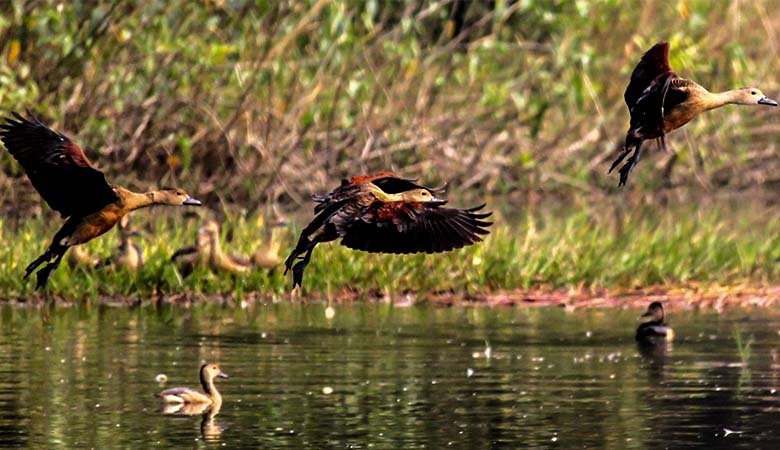
During the whole winter season, basically from the onset of October to late of April, they stay on the campus. But in this year migratory birds start coming from the early of September. The mind-blowing scenario is plotted when Birds swarm over the lakes, quiz one another, and when the yellowish-black bird crowd starts flying simultaneously from the colorful water lily, especially red-coloured variety.
The chirping and fluttering of birds all around the lakes of JU are as exclusively beautiful as ever. During this time of the year, campus dwellers wake up listening to the chirps of the visitant birds and hundreds of visitors flock on the campus to enjoy the beauties of migratory birds as well as the university campus. In winter university campus gets a new dimension of beauties not only for migratory birds but also the placate weather and for the presence of different species of birds and butterflies.
Meanwhile, a large number of passionate bird loving people have started gathering to charm their eyes and enjoy migratory birds chirping and fluttering near the lakes. Tuhin Parves, a student of Bangladesh University of Professionals who came along with his friends to see the migratory birds on the campus for the first time, said, “I’ve never seen so many birds flocking together in one place. When yellow-black mixed birds were flying over my head I was stunned! Really, the beauty of this scene cannot be expressed in words”.
Though the number of migratory birds in the Bangladesh has dramatically decreased due to climate change and other natural phenomenon, apparently, the scene on the JU campus is really different. This year a great number of migratory birds have arrived.
Last year, the number of birds migrating through and to JU was reduced because of rampant poaching, fish farming in the lake and owing to contamination of the waters. This year, the authorities at JU have made special arrangements for the migratory birds.
According to an analysis of the Zoology department of the university, two types of birds come to the campus. One type takes rest in dry places like tree branches and the other one takes rest in lake water. Their physical structures and habituates are similar to that of the ducks. Around nine species of migratory birds come to JU every year. Boro Sorali which is known as greater whistling ducks and Chhoto Sorali which is known as the lesser whistling ducks are found more in JU lakes than other species. Moreover, a total of 135 species of indigenous and 69 species of foreign birds out of 204 species are seen on the campus.
In association of Zoology department, the university arranges ‘Birds Fair’ every year featuring with various events, such as inter-university bird identification competition, bird painting competition for children, arrangements for children to watch migratory birds from different spots with telescopes, quiz competition, discussions and cultural sessions relating to birds included in the daylong programme for creating mass awareness regarding bird conservation, and balancing eco-system.
“Although we are so much happy that on this occasion of seeing migratory birds a lot of people are coming to our campus, which undoubtedly is a big pride for us, the migratory birds are coming less in recent years due to lack of proper living places and excessive crowd. But in this year we’ve seen a lot of brids have come. I hope, in December this number will increase. Hundreds of people gather to enjoy the beauties of birds, but some of them erroneously tease and scream at the birds. These types of behaviours disturb the birds and as a result their number has shrunk,” said Professor Kamrul Hasan of Zoology department.
The fort-like red coloured buildings, the evergreen trees, waterlily-decorated lakes, the calm and quiet environment of the Jahangirnagar University have made the campus really a heaven for birds which is now a central attraction for many people, specially for those who reside in the dusty brick lanes of the urban sprawl and city of Dhaka.