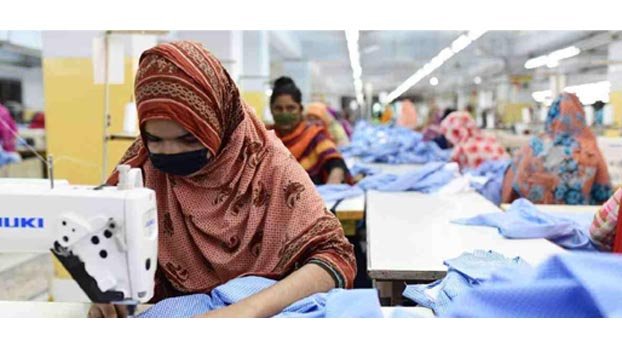
The workers in the Ready-Made Garments (RMG) industry are likely to face serious financial constraints should the Covid-19 situation get any worse.
Speakers at a discussion meeting on Tuesday said that most of the workers engaged in RMG face severe financial hurdles as about 80 percent of the workers in the country have no savings.
The speakers suggested that such ‘fragile’ group of workers should have some sort of social protection to overcome crisis like the corona crisis and also organize skill development programmes to ensure they have scopes of income during any major financial crisis.
The dialogue on ‘Unpacking Socio-economic Vulnerabilities: Impact of Covid-19 Pandemic on RMG Industries in Bangladesh’ was held at a city conference hall in Kawran Bazar on Tuesday.
Bangladesh Occupational Safety Health and Environment (OSHE) Foundation and SRS jointly organized the dialogue with support from Manusher Jonno Foundation (MJF).
The speakers at the dialogue said that all the stakeholders, including government, industry owners and RMG workers should work together to resolve any problem. They also suggested that the government should ensure fair representation of the RMG workers in all of its policy and planning stages.
AKM Masumul Alam, an expert on labour law and Alam Hossain, Director of OSHE Foundation, jointly presented the key note paper at the programme.
President of Jatiya Sramik Federation Quamrul Ahsan chaired the dialogue, while Sekander Ali Mina moderated the programme.
It was addressed, among others, by Executive Director of Manusher Jonno Foundation Shaheen Anam, Director of Department of Labour SM Anamul Haque, Member Secretary of National Coordination Committee for Workers’ Education (NCCWE) Naimul Ahsan Jewel and Senior Director of Grameen Health Programs of Gonoshaysta Kendra Dr Rezaul Haque.
Alam Hossain and AKM Masumul Alam in their presentation revealed that about 80 percent of the RMG workers have no savings. Many of the RMG workers have been suffering from mental and psychological stress and other mental disorders after losing jobs in Covid-19 pandemic.
“As a result, suicidal tendency among the workers is increasing among the affected workers,” explained Alam Hossain. “Sometimes they are deprived from reliefs and other benefits provided by the government due to the lack of awareness and knowledge among them,” he added.
They said that many such workers who were terminated, mostly from smaller garments factories, during the pandemic, had to agitate out on the streets to realize their pending salaries.
“Many of the workers were laid off without following any rules or regulations where trade unions are not allowed. Such acts of disregarding the workers were found to be very disturbing in which many of them were forced to resort to violence to realize their legitimate demand.”
The speakers called upon all the stakeholders including government, workers’ organisations and owners of the industries, to work together in overcoming the coronavirus crisis.
The speakers concluded by making strongly recommendations for addressing the problems related to mental health of the workers, ensuring job security, preventing illegal termination and contributing to promoting better life and livelihood of the workers.
According to the International Labour Organisation (ILO), a total of 1.6 billion people lost their jobs in the informal sector globally. To address the existing problem, the speakers placed several recommendations, including ensuring financial assistance, treatment and counseling for mental health and re-organizing the existing social services.