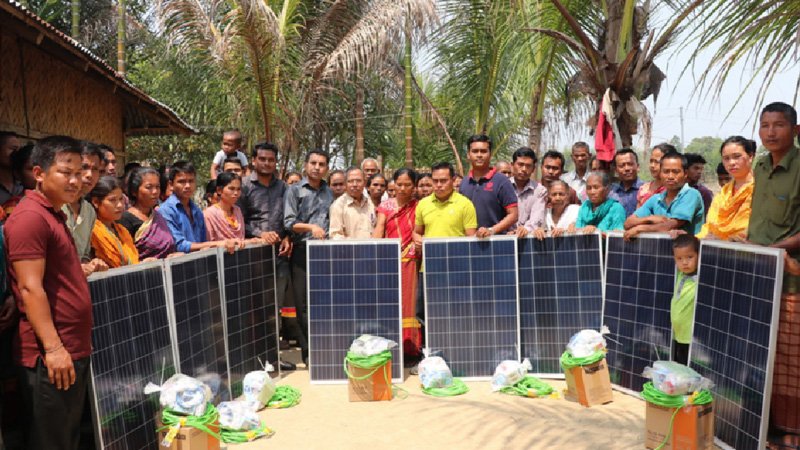
The government plans to distribute solar power systems free of cost to some 42,500 more households in remote areas of Chattogram Hill Tracts (CHT), where electricity from the national grid has not reached as yet.
Prime Minister Sheikh Hasina recently approved a project in regard for the benefit of mostly the tribal families.
The Chattogram Hill Tracts, comprises three hill districts - Rangamati, Khagrachhari and Bandarbans. As it is a difficult terrain, power from national grid line cannot be supplied in the near future there.
Dr Prakash Kanti Chowdhury, Member (Planning) of CHT Development Board, told Bangladesh Post, “We are waiting for final letter from Planning Commission. Hopefully the project will be implemented next month.”
He said, “The Prime Minister has promised that all people will come under electricity coverage by ‘Mujib Barsho’. As part of that the government is giving top priority to this project. The people in remote areas will get electricity facility through the project, where it is not possible to provide and connectto the grid electricity in next 15-20 years.”
Sources said that under this project, 40,000 solar home systems will be installed, each with a capacity of 100 watts. Besides, another 2,500-community based solar systems with 320 watts capacity each in neighbourhoods, hostels, orphanages, community centres and religious institutions will be installed.
This community-based solar system will also be able to generate electricity for extra income. Through this, educational activities will be conducted in schools through multimedia projector. Local people will be able to do other useful work at night besides handicraft work.
Earlier, the first phase of the project, named "Power Supply through Installation of Solar Panels in CHT Remote Areas," was completed worth Tk 76.06 cr in June 2019.
Some 10,890 families are now getting electricity facility through solar home systems under the first phase. Additionally, electricity was supplied to various educational and religious institutions through 2,814 community-based solar home systems.
People of indigenous communities in the hill districts mainly depend on Jhum cultivation, also known as shifting cultivation for livelihood. The communication system in CHT region is very poor and time-consuming. That is why this part of the country remains behind in terms of active development.
According to power division, the government has taken various initiatives to enhance generation of renewable energy as part of its efforts to ensure energy security keeping carbon dioxide emissions at low level.
Bangladesh is now generating 630.96 megawatts (MW) of electricity from renewable sources. The government has set a target to increase renewable energy generation to 2,000MW by 2021 and to 6,000MW by 2041.
The country has attained outstanding success in the field of green energy as it secured the second position in producing renewable energy (RE), especially off-grid solar solutions.
According to REN21's Renewables 2020 Global Status Report (GSR) published recently, Nepal topped with 11 percent access to electricity from off-grid solar systems, while Bangladesh and Mongolia jointly ranked second with eight percent power from the same sources.
According to Bangladesh Solar and Renewable Energy Association (BSREA) so far, around 6 million Solar Home Systems (SHS) have been set up in remote areas across the country with the direct patronization of Prime Minister Sheikh Hasina, which is currently directly and indirectly benefiting about 3 (three) crore disadvantaged rural people. This is the largest and most globally renowned Solar Programme.
State Minister for Power, Energy and Mineral Resources Nasrul Hamid has said that renewable energy would ensure future energy security. The government is committed to expanding of renewable energy. It has developed a power generation strategy based on fuel diversification to enhance energy security.
Earlier Dipal Chandra Barua, President of BSREA told Bangladesh Post, “The government is more sincere about increasing the use of renewable energy in the country. Now we have to spread the use of renewable energy in all fields. We can generate at least 2,000 MW of electricity by 2021 from solar irrigation pumps and rooftop solar panels alone. By doing so, the goal of generating electricity from renewable energy within the next year will be achieved effortlessly.”
Once upon a time, it was darkness in remote areas of Teknaf’s Hnila in Cox’s Bazar. Now around 40,000 users are enjoying electricity facility through a 20MW solar power plant, which is the country’s largest solar plant.
After fulfilling local demand, around 3 MW electricity is being added to the national grid. The Bangladesh Power Development Board or BPDB had previously signed a 20-year deal for the power with its owner, Joules Power subsidiary Technaf Solartech Energy Ltd.