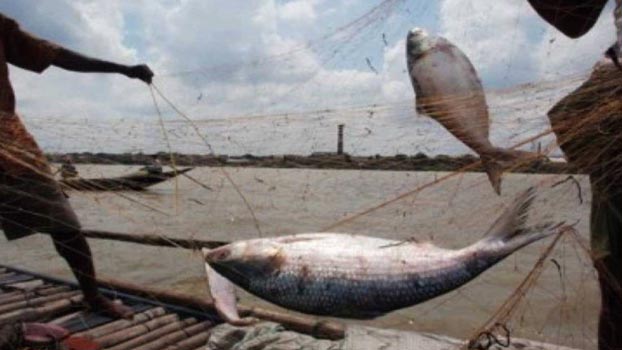
Considering the breeding season of the national fish Hilsa, all types of fishing in the Bay of Bengal and Hilsa roaming rivers has been banned for 22 days, beginning midnight Tuesday, up to November 4.
Almost all government agencies have been involved in the largest fishery protection programme conducted in 36 Districts and 152 Upazilas of the country to bring back the golden age of the silvery Hilsa. The Department of Fisheries, DoF said strict action will be taken against those who violate the ban, and surveillance will be increased at the boundary and trans-boundary rivers.
The sale and transportation of Hilsa has been banned during this period from 14 October to November 4.
Scientific research has shown that 15 days before and after the full moon in October, Hilsa fish come to the freshwater rivers and estuaries of Bay of Bengal to lay their eggs. That is why, like in previous years, to protect mother Hilsa, all types of fishing will be stopped at this time of the year.
The results of this ban period are also available. The golden days of silver Hilsa have started to return. In the last ten years, the production of Hilsa has doubled to 550,000 tons.
Sirajur Rahman, director of the DoF, said all the government's field-level administration has been involved in the districts and Upazilas concerned to enforce the ban, and surveillance has also been stepped up at sea and inland rivers.
“The main function of this fish conservation programme is publicity, he said, “Fishermen are being told that if they do not catch fish for a few days, they can catch extra fish at other times of the year. If anyone goes on fishing without heeding it, he must be punished “
“In 152 sub- districts of 36 districts all government agencies and forces including Bangladesh Navy, Bangladesh Airforce, Border Guard Bangladesh BGB, and Coast Guard are also involved in this programme, Sirajur Rahman said.
A Department of Fisheries source said, extensive campaigns, including miking and postering, are being carried out in sea and riverside fisher villages to enforce the ban.
Government has allocated 10500 tonnes of rice for the fishermen affected by the fishing ban. 533,000 fishermen of the whole country will be given 20 kg of rice per family by the government. The rice will be delivered to the fishermen as soon as the ban starts.
All fishing boats and trawlers from the sea have been instructed to return to shore by 5pm on Tuesday.
Farhana Lovely, District Fisheries Officer of Chattogram said fish markets and ice factories in different areas along the seashore have been directed to close, or restrict their activities.
“We go to the fishing villages one after another and tell them not to fish. As we have been running this campaign for the last several years, the fishermen have become accustomed to not fishing at this time of the year,” she added.
Farhana also said, “even then, if anyone tries to fish in violation of the ban, mobile courts are deployed to ensure punishment.”
Fishermen communities said as a result of campaigning for several years all fishermen stay ashore at the time of the ban. But they were concerned about the stealing of fish from our territory by the fishermen of neighboring countries during the absence of local fishermen.
Unexpected incidents took place between the BGB and the Indian Border Security Force last year when Indian fishermen stole fish from the Bangladesh border during a ban on the Padma River.
Aminul Islam Babul, Secretary of Mechanized and Non- mechanized Fishing trawlers Association said , on both sides of the Bay of Bengal from India,on the western side, and from Myanmar on the eastern side fishermen entered our territory to steal fish.
Director of DoF Sirajur Rahaman said, in the context of incidents of previous years, all attempts have been taken to protect our national resource as the Navy and the Air Force are on high alert. If necessary, the forces will monitor at sea using aircraft.
Hilsa fish is the single largest species of natural origin, accounting for 10-12 percent of the total fish production in the country. Bangladesh accounts for 80-85 percent of the world's Hilsa production, with a market value of Tk 17,000 crore.