With the record number of testing, the government in its latest update on Saturday reported nine new confirmed cases of coronavirus or COVID-19 and two more deaths related to the disease.
It is the biggest single-day increase in Bangladesh and it brings the total number of confirmed cases to 70. The total deaths are now eight.
Four more patients tested coronavirus negative in consequent two tests within 24 hours, which means total 30 patients made complete recovery. Among the rest 32 patients, 12 are taking treatment from home and 20 from hospital.
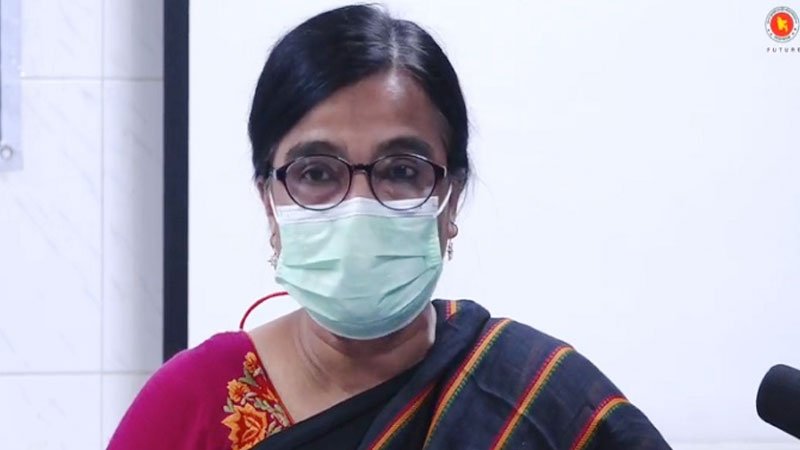
Director General for Health Services Prof Abul Kalam Azad and IEDCR Director Prof Meerjady Sabrina Flora updated media in an online briefing.
The jump of cases is primarily credited to the increase in number of samples collected and tested in the last 24 hours as part of the government’s plan to take the service across Bangladesh.
Prof Azad said they had collected 553 samples in the last 24 hours. Of them 434 were tested. Before that, the highest number of samples tested in a single day was 203 - five were found positive of them.
“We got the new nine cases by testing 434 samples,” the director general said.
Prof Azad, however, did not rule out community transmission which means anyone without travel and contact history with the patient can get the virus.
“We’ve been saying that limited community transmission is happening,” he said, when asked about the sources.
He asked people not to panic, rather be aware of the disease and stay at home.
“Wash your hands with soap, don’t touch your face with unwashed hands, cover your cough and sneezes and maintain physical distance with the affected person,” he said, while giving some advices. “If you feel fever or cough or throat pain which is very common in this season, stay at home and take over the counter medicines such as paracetamol and drink lukewarm water. You can call us in our numbers,” he said, giving the hotline numbers that include 16263 and 333 of the health directorate and I0655 and 019 44 333 222 of IEDCR hotlines.
“Trained doctors attend those calls and prescribe you what to do. Please follow their instructions,” he suggested, adding that they had received over 63,000 calls in the last 24 hours.
He once again urged private medical colleges and clinics to give services to the people. “We don’t want to be harsh during this time of crisis. But we have conveyed to them what kind of action we can take,” he said.
“We have expanded our sample collections to the upazilla level to understand the situation,” he said.
Of the new cases, eight were from Dhaka which is so far the hotspot of the virus and the other from outside Dhaka.
The IEDCR lab has confirmed eight cases and the other was confirmed by the outside lab.
The IEDCR director, however, they will retest that positive case while treatment and isolation of the patient will go on. “We are the only reference laboratory of the WHO. So we have to retest that,” she said.
Five of the new nine cases had the history to come to contact with the affected persons. Two returned from abroad. They are still trying to find source of the other two.
Of them, two were children below the age of 10. Three between the age of 20 years and 30 years, two between 41 years and 50 years, one between 51 years and 60 years and the other was 90 years old who died.
Another who died was 68 years old. Both of them had other complications such as heart problems.
The global death toll from the pandemic is close to 60,000. Over a million of people have been affected.
The UN Resident Coordinator and WHO Representative to Bangladesh drafted the Country Preparedness and Response Plan (CPRP) and circulated that to the Embassies, Development Partners and Donors.
The CPRP covers surveillance and laboratory, contact tracing and POE, case management and infection prevention control, risk communication and community engagement and logistics and procurement.
The requested amount for immediate response needs under the CPRP is $297 million.
Additionally, through local resource mobilisation, WHO Bangladesh raised $250,000 from DFID. DFID has agreed to support $3 million and $1 million for COVID-19 response at the central level in Dhaka and in Cox’s Bazar, respectively.
According to the WHO Bangladesh office, they are also receiving remote support from experts in the UK, to address the ongoing response. The World Bank approved $100 million loan on Friday.
The director general once again assured doctors of having adequate stocks of personal protective equipment (PPE) for the healthcare providers when needed.