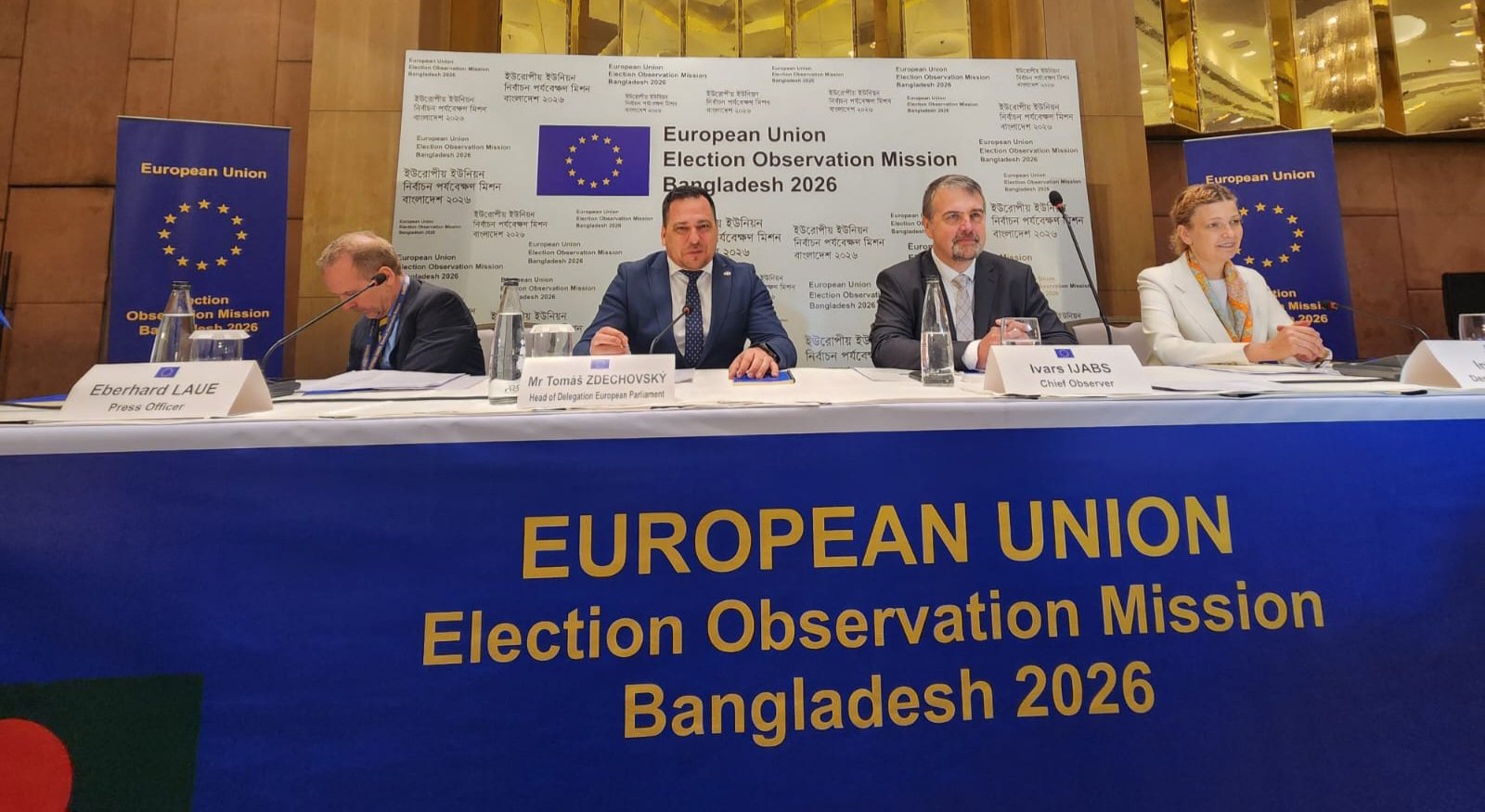
The European Union Election Observation Mission (EU EOM) has overall evaluated the 13th National Parliamentary Election, held on February 12, as "credible, competitive, and efficiently managed." However, the mission simultaneously issued a clear warning regarding several structural weaknesses, institutional gaps, and limitations in democratic inclusion.
Chief Observer and Member of the European Parliament, Ivars Ijabs, presented the preliminary statement, describing the election as a "crucial step toward restoring democratic governance and the rule of law." Tomáš Zdechovský, leading the European Parliament delegation, expressed full support for this assessment.
The EU Mission’s observations highlighted that voters had nearly 2,000 candidates to choose from, and competition was visible. Election day was described as peaceful, orderly, and "festive." The presence of party agents in most centers and the initiative to publish results at the local level helped maintain public confidence. While the mission noted that the legal framework is "largely consistent" with international standards and the Bangladesh Election Commission attempted to function independently and transparently, some issues were noted. These included the inconsistent application of security measures during counting and a lack of transparency in result tabulation in three observed instances. Furthermore, most polling stations were not accessible to voters with physical disabilities, signaling a failure to meet inclusive election standards.
During the press conference, Chief Observer Ivars Ijabs identified the limited participation of women as the "most concerning" issue. Women accounted for only 4 percent of total candidates, a significant deficit for representative democracy. Despite the visible role of women in recent mass movements, they were discouraged by party nomination processes, patriarchal social mindsets, discrimination, and a culture of character assassination. Instances of intimidation, direct harassment, and digital smear campaigns against female candidates were also documented. Observers urged Bangladeshi authorities to follow international conventions on women's rights and take effective measures for political participation.
The observer team reported that social media was highly active during the campaign. The mission identified at least 23 viral instances of misinformation reaching hundreds of thousands of people. Although national-level fact-checking initiatives existed, platform responses were slow, allowing misleading content to remain active for long periods. They claimed that personal attacks, mutual accusations, and divisive narratives dominated online discussions, weakening the quality of democratic dialogue.
The EU Mission documented at least 56 incidents of violence during the campaign, resulting in at least 200 casualties across 27 districts. While the violence was primarily local and isolated, it still negatively impacted the electoral atmosphere. When media representatives raised the absence of a major political party (Awami League) despite its historical support base, the Chief Observer stated that the EU monitors elections based on procedural standards. He viewed the high level of competition among participating parties as a "path to progress." Regarding the referendum, Ijabs noted that the EU generally does not monitor referendums as it falls outside their formal mandate, though he remarked that the strong "Yes" vote majority creates an obligation for the newly elected government to implement reforms.
On the topic of transitional justice, the Chief Observer described such issues as "painful and sensitive," but emphasized that elections and the rule of law are the primary paths to political progress. The mission has been in Bangladesh since late 2025, and on election day, 223 international observers from EU member states, Canada, Norway, and Switzerland were deployed across 64 districts. Post-election monitoring will continue, with a final report including recommendations to be published in the coming months.
The EU Mission’s evaluation frames the 2026 election as a positive step in the democratic journey. However, it made clear that this progress will not be sustainable without increasing female representation, preventing violence, controlling digital misinformation, implementing legal and institutional reforms, and ensuring minority inclusion. Finally, the observers called for the resolution of political disputes through dialogue and the rule of law rather than violence. To sustain the message of democratic renewal emerging from this election, structural reforms and inclusive political commitment are now essential.
In a press release issued after the conference, the EU stated that the representation of indigenous and religious minority communities remains insufficient. Their political inclusion is limited by the absence of affirmative action or positive discriminatory measures. Furthermore, the observation noted that the media remains under legal and institutional pressure. An increase in self-censorship and the slow pace of media reform processes are reportedly shrinking the democratic space.