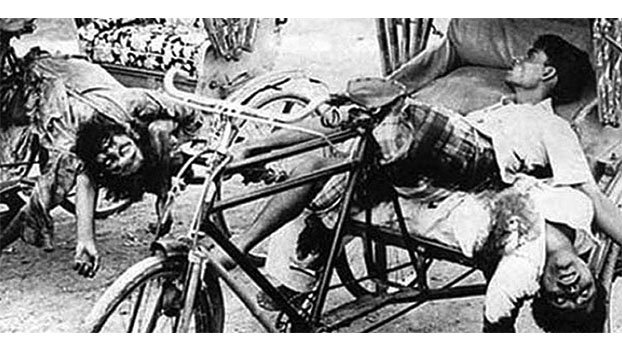
Fifty years ago, on the dreadful night of March 25, 1971, the people of the Bengali nation had to experience a nightmare of immense proportions when Pakistani marauders let all hell loose on them.
As per a blueprint of their pre-planned ‘Operation Search Light’ with the abominable aim of silencing the voices of the Bengalis forever, the barbaric Pakistani aggressors, armed with sophisticated weapons, including fighter planes, tanks and anti-aircraft guns, launched a crackdown on the unarmed sleeping people of Bangladesh.
The Pakistani army started wholesale genocide and killed millions of people during the nine-month war.
They unleashed a reign of terror throughout the capital, killing innocent people indiscriminately, ravaged villages and cities, raised inferno by burning houses and other establishments, and resorting to widespread loot.
When Rome was burning, Emperor Nero was playing flute. Similarly, Yahya Khan and his compatriots were full of glee over the table of wine when the sky was renting with the painful cry of men, women and children, who were being charged with bullets and fatal arms by the marauding military.
Human corpses were floating on rivers, canals and other water-bodies. The sulphuric smell of the cartridge filled the air and environment making it totally suffocating.
The brutality committed by the Pakistani army is cited to be the worst-ever genocide in the history of the world.
The genocide is recognised in the documents published by the government of Pakistan itself. The ‘White Paper on the Crisis in East Pakistan’ published by the Pakistani government during the Liberation War, states, "More than 100,000 people were killed between March 1, 1971 and the night of March 25, 1971."
The Pakistani army launched the massacre on innocent Bengali civilians in the name of the infamous 'Operation Search Light' instead of handing over power to the Awami League, which had won the general election in 1970 with the majority of votes.
The main objective of the massacre was the elimination of conscious citizens, the Awami League and the then progressive political leaders and activists of the then East Pakistan.
In the morning on March 25, 1971, Pakistan People's Party (PPP) chief Zulfikar Ali Bhutto had a 45-minute long meeting with Pakistani President Yahya Khan. And at least 11 people were killed in the firing by the Pakistani army at Rangpur, Syedpur and Chattogram.
Meanwhile, Bangabandhu Sheikh Mujibur Rahman expressed concern over the Pakistani government's excessive delay in resolving the country's political crisis.
But, a tense situation started to prevail all over the country including in Dhaka since noon as movements of the military were intensified from the morning. They started visiting different cantonments by helicopter.
The 22nd Baloch Regiment stationed at Peelkhana, the then EPR headquarters in Dhaka, was seen taking up positions at various places inside the Peelkhana, which is now the headquarters of the Border Guard Bangladesh.
At one stage, the Pakistani army launched attacks on Peelkhana, Rajarbagh and Nilkhet at midnight. The invading forces equipped with tanks and mortars occupied the Dhaka University and Nilkhet areas. The night in Dhaka city turned horrible with the firing of machine guns, tanks shells and other sophisticated firearms.
The Pakistani military made attacks on the female students at Rokeya Hall Dhaka University. They brutally killed at least nine teachers of Dhaka University, including professorsGovinda Chandra Dev, JyotirmoyGuhaThakurata, Santosh Bhattacharya and Moniruzzaman, who were at different halls. The biggest incident of brutality took place at Jagannath Hall, where the massacre continued till the morning on March 26.
Meanwhile, president Yahya Khan secretly left Dhaka for Karachi after finalising all the steps to implement the Operation SearchLight Plan.
On the other hand, at the beginning of the army operation, the invading forces arrested the undisputed leader of the Bengali nation Bangabandhu Sheikh Mujibur Rahman from his Dhanmondi residence. Before his arrest, Bangabandhu declared the independence of Bangladesh on March 26 (midnight on March 25) and called for building resistance against the enemy at any cost.
Responding to the call of Bangabandhu, the Bengalis jumped into the war against the Pakistani aggressors. And after a 9-month long armed struggle, the Bengali nation achieved its victory on 16 December 1971. The new state of Bangladesh emerged on the world map.
Commemorating the brutality of the Pakistani military or the genocide, the government has decided to observe one-minute symbolic ‘blackout’ at night today throughout the country.
The Ministry of Liberation War Affairs has taken an initiative to observe the blackout from 9:00pm to 9.01pm.
But, the key point installations (KPIs) and the essential establishments will remain out of the purview of the programme.
Besides, different political parties, socio-cultural organisations have also chalked out various programmes to mark the day.