Business Desk
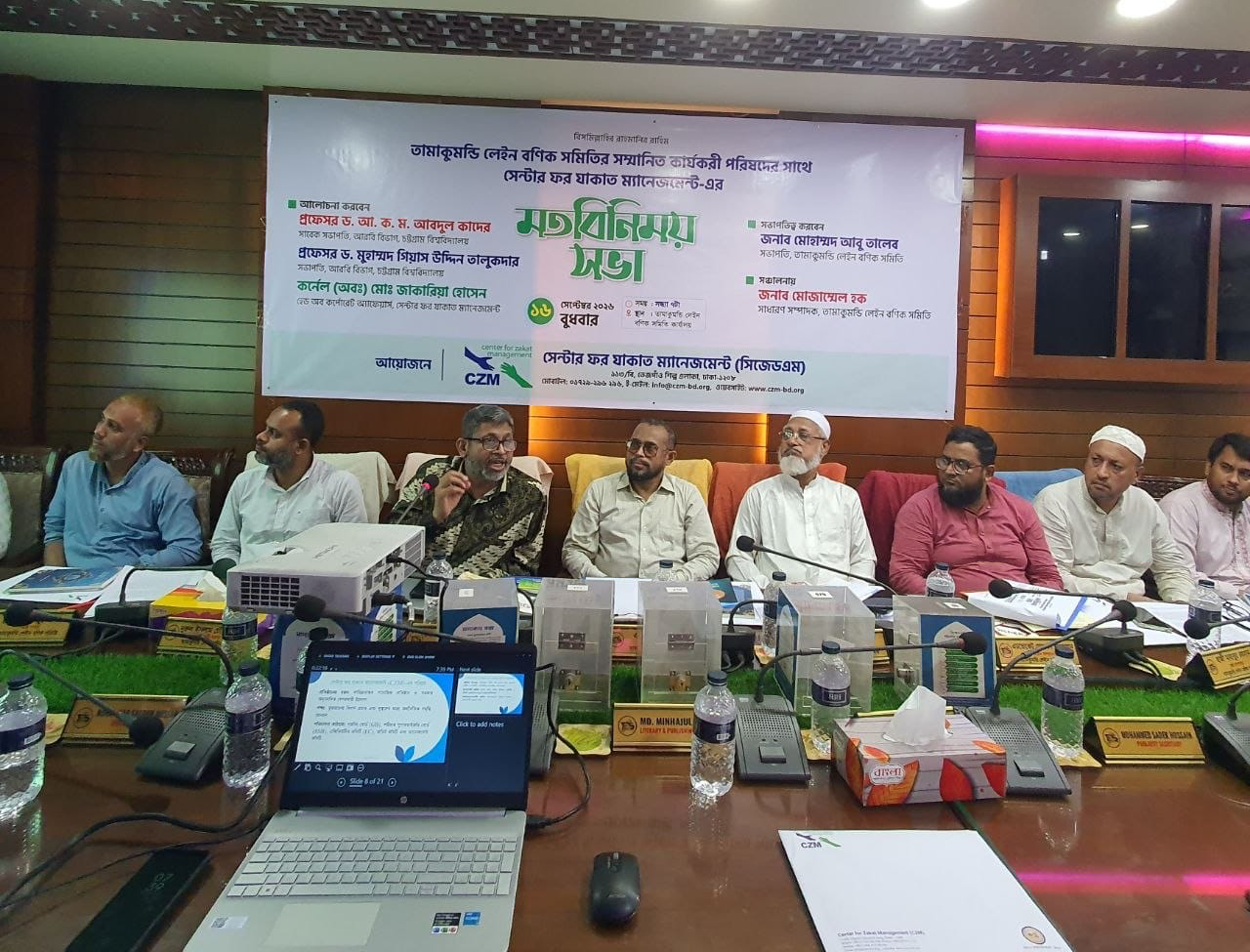
An exchange meeting between the Center for Zakat Management (CZM) and the respected Executive Council of Tamakumundi Lane Merchants’ Association was held today, Wednesday, at 7:00 p.m. at the office of Tamakumundi Lane Merchants’ Association.
At the meeting, discussions and an exchange of views took place on institutional zakat management, the religious and social significance of zakat, the effective role of zakat in poverty alleviation and improving people’s standard of living, and various aspects of correctly determining and paying business zakat.
Present as the chief discussant at the meeting was Professor Dr. A. K. M. Abdul Quader, former Chairman of the Department of Arabic at the University of Chittagong and member of the Shariah Supervisory Board of the Center for Zakat Management (CZM).
Colonel (Retd.) Md. Zakaria Hossain, Head of Corporate Affairs of the Center for Zakat Management, presented a discussion titled “Institutional Zakat Management and Poverty Alleviation: A Journey from Dependence to a Dignified Life.”
The meeting was presided over by Mohammad Abu Taleb, President of Tamakumundi Lane Merchants’ Association.
The program was conducted by Faruk Azam, Senior Vice President of Tamakumundi Lane Merchants’ Association.
Senior Manager Mohammad Hossain Sohel and Assistant Manager Baker Hossain of the Center for Zakat Management, as well as members of the Executive Council of Tamakumundi Lane Merchants’ Association, were present at the meeting.
Speakers at the meeting said that zakat is an important obligatory act of worship in Islam. Its main purpose is not merely to give a fixed portion of wealth; rather, through it, opportunities are created to increase the economic capacity of the poor and deprived people of society, improve their standard of living, and gradually make them self-reliant.
The speakers further said that if zakat funds are used through proper planning and institutional management, they can bring about long-term change alongside meeting a person’s immediate needs.
Instead of merely assisting a poor person, if he is given the opportunity to acquire income-earning capacity, then in the future that person himself may reach a position to assist others.
In this way, zakat can become a means of increasing the economic capacity of an individual and family as well as bringing positive change in society.
At the exchange meeting, the issue of correctly determining and paying the zakat applicable to personal wealth and business assets was also discussed with importance. In particular, emphasis was placed on the need to raise awareness among the business community about correctly calculating business zakat and paying zakat according to proper rules.
The speakers said that it is important to acquire necessary knowledge and advice to ensure the correct calculation of zakat and its payment to the proper sectors. If zakat is paid through institutional management, it is possible to ensure a more planned and accountable system in its collection, management, distribution, and monitoring.
It was further said at the meeting that one of the most important social objectives of zakat is the improvement of the economic condition of the poor and deprived. By using zakat funds in a planned manner, it is possible to conduct various activities for the poor population, including income-generating activities, education, healthcare, and technical and skills development.
The speakers mentioned that instead of providing assistance only for immediate consumption, if productive capital and necessary support are delivered to poor people by considering their needs and capabilities, their opportunity to become self-reliant increases.
Through this, an opportunity is created to bring lasting change in the life of the zakat recipient as well.
At the meeting, various activities of the Center for Zakat Management were also discussed. CZM has long been working through institutional zakat management to collect zakat funds, use them in a planned manner according to the needs of the poor and deprived, and monitor the activities.