Business Desk
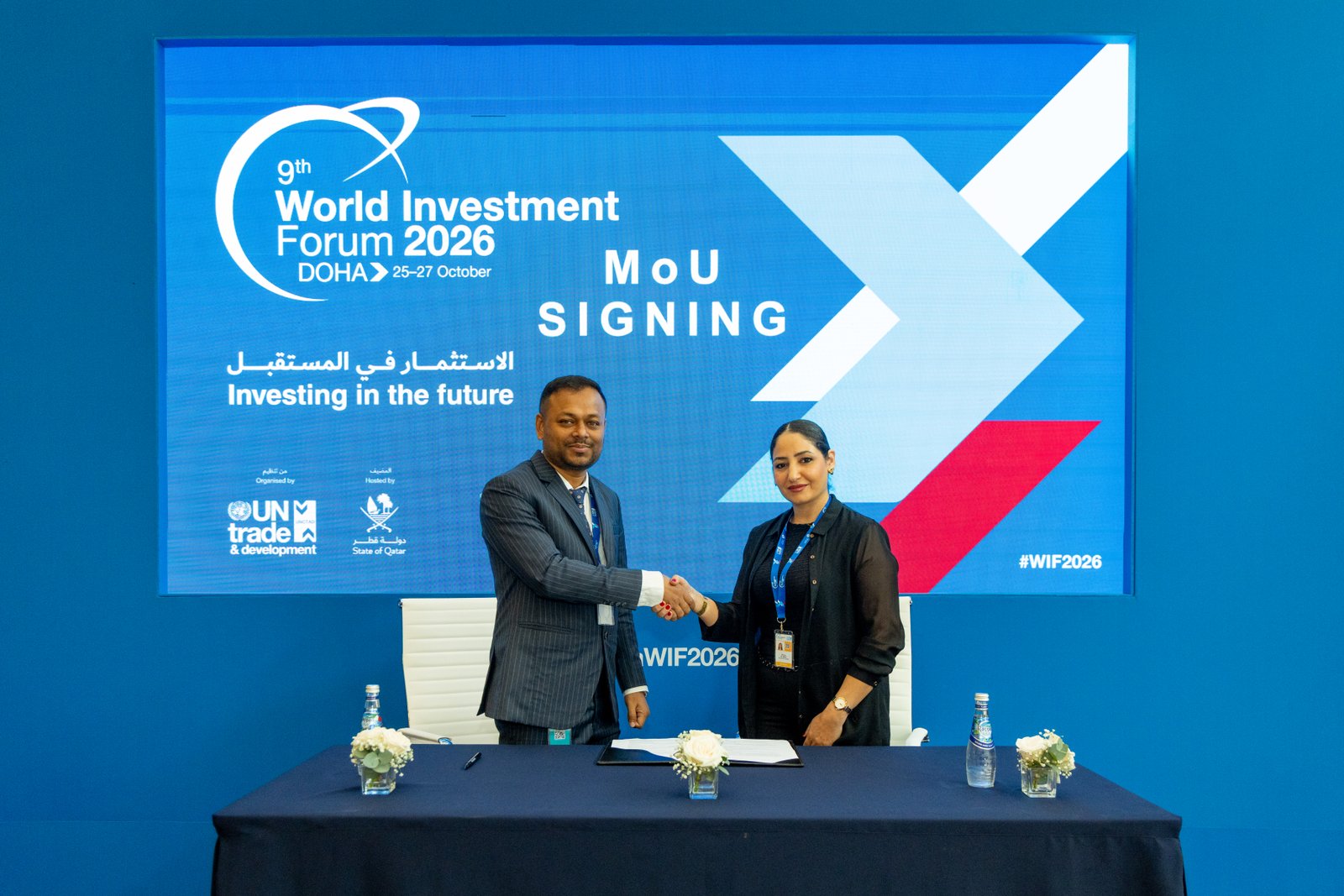
Bangladesh-based technology and sustainability company Smart Build has signed a Memorandum of Understanding (MoU) for international technical and strategic cooperation during the World Investment Forum 2026 in Doha, marking another step in its ambition to bring Bangladesh-developed artificial intelligence technology to global water management markets.
The agreement was signed with NEFER SARL, represented by Nisrine El Awar, project owner of the Revival Silk Heritage initiative and delegate associated with ET Cernay and the MEDEF delegation.
The cooperation framework includes opportunities to explore intelligent water management, sustainable industrial processes, resource efficiency and technology integration. Smart Build is separately pursuing wider opportunities for its AI-Powered Water Intelligence technology across nearly 20 prospective markets in the Middle East, Africa and Europe.
The development took place during the ninth World Investment Forum, organised by United Nations Trade and Development (UNCTAD) in partnership with the State of Qatar from October 25 to 27.
The high-level global gathering brought together heads of government, ministers, international investors, business leaders and representatives of development institutions to discuss investment, technological transformation and sustainable development.
According to Smart Build, its representatives engaged with senior government officials, ministerial delegations and other international stakeholders on the potential application of artificial intelligence in water security, wastewater management, energy efficiency and environmental sustainability.
The discussions highlighted growing interest in AI, the Internet of Things (IoT), real-time monitoring and predictive intelligence as tools for addressing increasingly complex water challenges.
Water security is central to national development:
Md. Shahab Uddin Riyad, Chief Sustainability Officer of Smart Build, said the company's participation in the international forum reinforced its understanding that water management is becoming a strategic priority for governments worldwide.
"One of the most important lessons we have learned here is that water management is no longer simply an environmental or infrastructure issue. It is directly connected to a country's economic development, public health, energy security, industrial productivity, sustainability and the stability of its entire environmental ecosystem," Riyad said.
"Every country depends on water, and almost every major sector of an economy depends on effective water management. This is why we have seen such remarkable interest among global leaders in emerging technologies, particularly artificial intelligence and IoT, and how these innovations can transform the future of the water sector."
He emphasised that the relationship between water and energy makes intelligent water management particularly important.
"Water extraction, pumping, treatment, distribution and wastewater processing require significant energy. As global water demand increases, countries must find smarter ways to manage both water resources and energy consumption. We believe artificial intelligence can play a transformative role in this transition," he added.
The International Energy Agency has previously estimated that water-sector operations account for approximately 4 per cent of global electricity consumption, highlighting the potential importance of improved operational efficiency and energy optimisation.
From industrial wastewater to comprehensive water intelligence:
Smart Build initially focused its technology development on industrial wastewater management, particularly using artificial intelligence to improve treatment efficiency, monitor environmental parameters and support industrial compliance.
However, the company says its technology architecture was designed from the outset to support applications across multiple water-related sectors.
Shafkat Alam, Chief Technology Officer of Smart Build, said the strong international response reflects the broader potential of the company's PureFlow AI-Powered Water Intelligence platform. "Just a week before participating in the World Investment Forum in Qatar, we attended WETEX 2026 in Dubai, where our technology received significant interest from international industry leaders and stakeholders," Alam said.
"Although we initially started with industrial wastewater management, we developed our core technology architecture with a much broader vision. Our objective was to create an intelligent and scalable platform capable of supporting different areas of water management rather than building a solution limited to one industry."
He explained that the PureFlow platform is designed to integrate IoT sensors, artificial intelligence, real-time data analytics, predictive monitoring and automation capabilities to help organisations make better water management decisions. Potential applications include municipal water supply, industrial wastewater treatment, agricultural irrigation, water distribution networks, desalination, environmental monitoring and intelligent water reuse.
"Water is a universal requirement. Every country, every industry and every community needs it. This creates enormous opportunities for a technology platform that can be adapted to different geographical conditions, infrastructure systems and regulatory environments," Alam said.
Exploring the next frontier:
Water intelligence in space Beyond terrestrial water infrastructure, Smart Build is also exploring the long-term potential of applying its intelligence technology to future human habitats beyond Earth.
According to the company, discussions during the international engagement programme included an exploratory exchange with a China-based company concerning technological requirements for potential future human habitation in space.
Smart Build said the discussions touched on ambitions relating to human space habitation around 2030 and the potential importance of advanced water monitoring, recycling and resource optimisation in such environments.
"Water management will remain critical wherever humans live, whether on Earth or eventually beyond it," Alam said.
"If human settlements become a reality in space, intelligent water monitoring, recycling and optimisation will be essential. We believe technologies like PureFlow could eventually contribute to those future challenges."
The company stressed that such applications remain a long-term technological vision rather than an announced space project or commercial deployment.
Positioning Bangladesh as a global water technology innovator
Smart Build believes its participation in two major international events, WETEX 2026 in Dubai and the UN World Investment Forum in Doha, Qatar, has opened opportunities for international collaboration, technology partnerships and investment discussions.
The company aims to strengthen its engagement with government agencies, development institutions, utilities and industrial operators in the Middle East, Africa and selected European countries.
Alam said the experience demonstrated the opportunity for Bangladesh to contribute not only as a consumer of advanced technologies but also as a developer and exporter of innovative solutions addressing global challenges.
"Our ambition is not simply to build a successful technology company. We want to demonstrate that innovation developed in Bangladesh can contribute meaningfully to solving some of the world's most important problems," he said.
"Water connects our economies, our health, our food systems, our environment and our future. If we can make water management smarter and more sustainable through artificial intelligence, we can create value for countries, industries and communities across the world."
He added that Smart Build would continue discussions with international partners to explore pilot projects, technology integration, investment opportunities and country-specific cooperation.
The company sees its growing international engagement as a potential pathway towards establishing Bangladesh as a recognised contributor to global water intelligence, climate technology and sustainable digital infrastructure.